


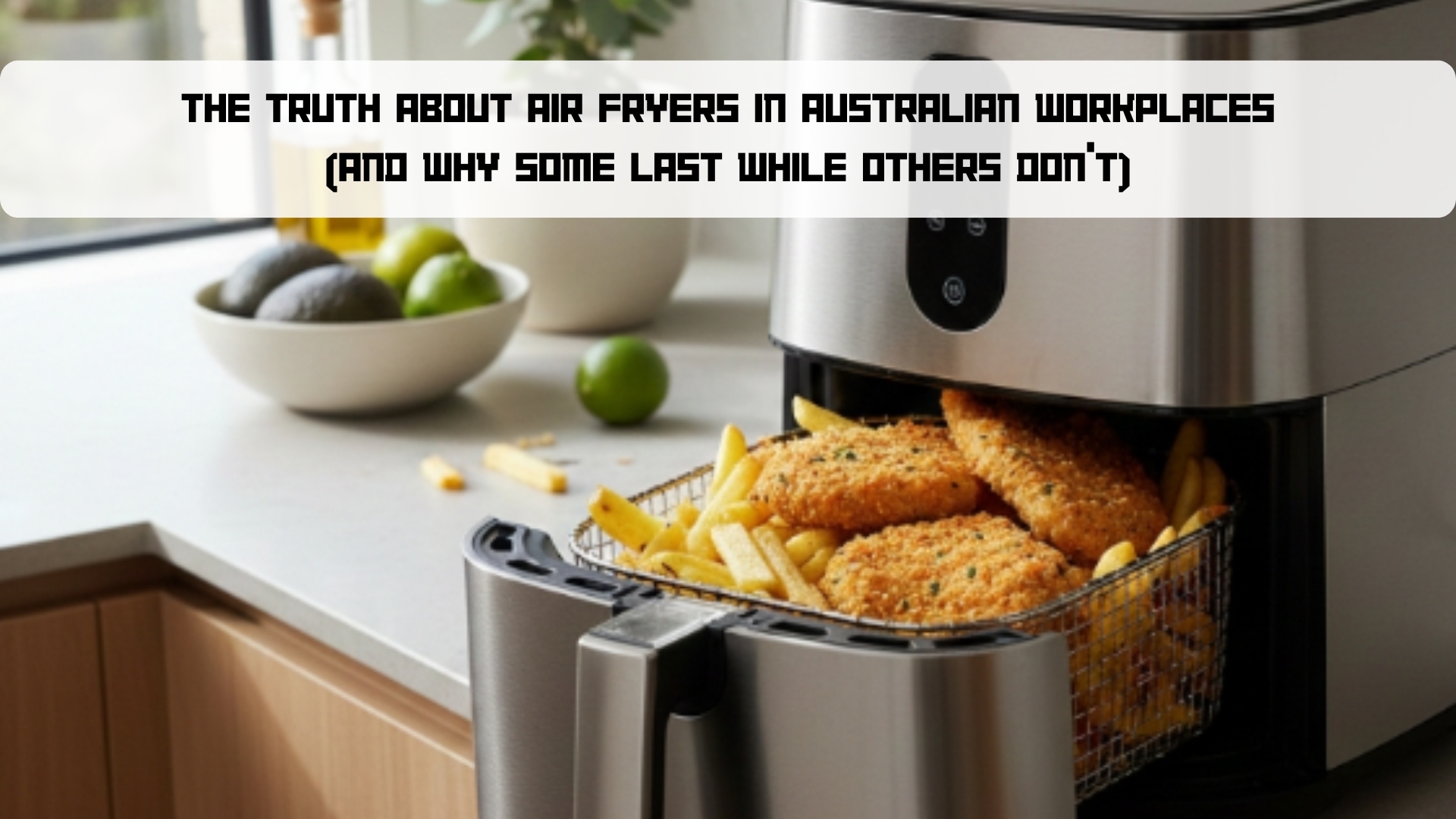
There’s a moment in almost every shared workplace kitchen when someone says, “We should just get an air fryer.”
It usually happens after a smoky microwave incident, a pan left soaking for two days, or yet another complaint about the smell of reheated fish drifting into reception.
On paper, an air fryer feels like the solution.
In reality, it’s either the quiet hero of the staff room… or the appliance everyone resents within three months.
The difference isn’t luck. It’s how you choose it, where you put it, and whether anyone takes ownership once the novelty wears off. It’s also about thinking beyond the initial purchase — knowing you can access replacement parts for appliances in the kitchen delivered across Australia makes it far more likely your “great idea” won’t end up as just another broken gadget gathering dust in the corner.
Why air fryers actually make sense at work
When they work, they really work.
In offices, they cut down splatter and that lingering greasy smell you get from stovetop reheating.
In hotels and small venues, they’re handy as a backup when the main line is flat out and you just need something consistent and contained.
In medical centres and sensitive environments, they’re chosen because they’re enclosed, predictable, and easier to keep tidy than open cooking surfaces.
In serviced apartments, they’re often seen as a safer, simpler amenity than telling guests to navigate a cooktop they’ve never used before.
But here’s the quiet truth: air fryers succeed in workplaces that treat them like shared equipment — not personal toys.
That mindset shift changes everything.
The real question isn’t “What’s the best air fryer?”
It’s “What’s the best air fryer for this group of humans?”
Because workplaces aren’t controlled environments. They’re unpredictable ecosystems of different habits, standards, time pressures, and personalities.
If ten people use it, you don’t get ten levels of care — you get the lowest common denominator.
So you have to buy and set up accordingly.
Capacity: Plan for behaviour, not optimism
At home, if you have to wait five minutes for a second batch, it’s mildly annoying.
At work, waiting creates queues. Queues create impatience. Impatience creates shortcuts.
Someone overfills the basket. Someone cranks the heat. Someone skips the wipe-down.
If you’re choosing a size, don’t think about total staff headcount. Think about the 30–45 minute lunch window. How many people realistically want to use it at once? Are they reheating snacks, or full meals?
Undersize it, and you’re indirectly creating misuse.
Placement: The mistake that ruins good appliances
I’ve seen perfectly decent units become smoke machines simply because they were shoved under cupboards with no airflow.
Air fryers need space. They vent heat. They move air aggressively.
In home kitchens, that’s manageable. In staff kitchens, bench space is often tight, appliances are crammed together, and power boards multiply like rabbits.
Choose the location first. Measure it. Confirm airflow clearance. Then buy to suit that space — not the other way around.
If it has to be dragged out every time someone uses it, it won’t be treated well.
Controls: Assume someone will improvise
Workplaces are full of “just try this” energy.
Simple controls often survive better than clever ones. Dials can be more forgiving than complicated touch panels.
Digital presets are great if they’re clear. Not great if someone can accidentally set 200°C for 40 minutes because they’re distracted.
The best control system is the one that quietly prevents extreme settings, empty runs, and overloaded baskets.
If you have rotating staff or casuals, prioritise clarity over features.
Cleaning access: This is the deal-breaker
If cleaning it feels annoying, it won’t get cleaned properly.
That’s not a moral judgment. It’s just how shared spaces work.
Look closely at baskets and trays. Do they remove easily? Are there awkward crevices? Does grease look like it would get trapped behind vents or design ridges?
Once you know what capacity and footprint you need, it’s practical to compare options in one place — the Appliance Factory Outlet air fryer range makes it easier to assess basket size, control simplicity, and how straightforward the removable parts look.
If it appears fiddly now, it will be worse after six weeks of shared use.
Smells: The thing no one talks about until it’s a problem
At home, food smells like… food.
In workplaces, smells become complaints.
Open-plan offices carry odours further than you expect. Shared HVAC spreads it. Reception hears about it.
Some foods will always be messier or smellier. That’s reality. If the workplace is sensitive — clinics, reception desks, meeting-heavy environments — then odour control is part of the buying decision.
It’s also part of the rule-setting.
Power: The quiet technical risk
Air fryers draw real power.
So do kettles. So do microwaves. So do coffee machines.
If they’re all on the same circuit in an older building, something eventually gives.
Before rollout, check what shares the outlet. Especially in hotels, venues, or older office buildings.
It’s better to have that conversation before the first lunchtime blackout.
Basket vs oven-style: It’s about maintenance tolerance
Basket-style units tend to be simpler for staff kitchens.
They’re intuitive. Quick. One main cavity to worry about.
Oven-style air fryers can be useful for spreading food out, especially in hospitality back-of-house. But they usually have more internal surfaces — which means more surfaces to clean.
In shared environments, every additional surface increases the odds of neglect.
The “right” format is the one your cleaning reality can support.
Cleaning routines: Clarity beats good intentions
In most workplaces, the failure point isn’t laziness.
It’s vagueness.
Nobody knows what “clean enough” looks like.
A realistic routine might be:
Daily: Empty crumbs, wipe touch points, check for visible grease.Weekly: Proper wash of removable parts, inspect vents.Monthly: Review placement, power load, and whether standards are slipping.
The magic isn’t in complexity. It’s in consistency.
Operator Experience Moment
I’ve watched two identical air fryers in two different workplaces age very differently.
One had a laminated A4 sheet beside it: “What not to cook. How to wipe it. Who to tell if something goes wrong.”
It stayed clean.
The other had no visible standard. Within weeks it smelled burnt. People stopped wiping it properly. Eventually it became “that appliance” nobody wanted to deal with.
The difference wasn’t the product. It was ownership.
Practical Opinions (exactly 3 lines)
Prioritise cleaning access over extra cooking modes.If smells matter at your site, decide the location before choosing the model.Buy for the least confident user, not the most enthusiastic one.
The common mistakes that quietly sabotage everything
Buying based on advertised capacity instead of real lunch behaviour.Assuming “someone will clean it” without assigning responsibility.Placing it in cramped corners with poor airflow.Letting foil or liners block airflow and create smoke.Ignoring circuit load until something trips mid-rush.Choosing complexity in high-rotation workplaces.
Avoid those, and most air fryer problems disappear before they begin.
Local SMB mini-walkthrough (Australia): A realistic shared setup
Step 1: Walk the space and lock in the location first — airflow, bench clearance, power point.Step 2: Decide who owns it (office manager, facilities, supervisor, cleaning checklist).Step 3: Create a short “allowed / not allowed” food list.Step 4: Choose a unit that fits the space and is straightforward to clean.Step 5: Add a laminated routine and keep wipes or a brush nearby.Step 6: Review after two weeks and adjust based on real behaviour.
A practical 7–14 day action plan
Day 1–2: Confirm location and power capacity.Day 3–4: Draft a simple shared appliance standard.Day 5–7: Compare 2–3 suitable models based on cleaning access and capacity.Day 8–10: Install and run a short internal trial.Day 11–14: Assign ownership formally and embed the routine into your facilities checklist.
Do this, and you avoid the most common workplace outcome: a decent appliance becoming unusable because no one defined how it should be used.
Key Takeaways
- In workplaces, behaviour matters more than features.
- Cleaning access and odour control are bigger factors than cooking modes.
- Placement and power should be decided before purchase.
- Ownership and clarity prevent almost every shared-kitchen issue.
Common questions we hear from Australian businesses
How do we choose the right size air fryer for an office?Usually it comes down to peak-time demand, not total staff numbers. A practical next step is to observe lunch patterns for a week and estimate how many people want to use it in the same 30–45 minute window. In many Australian offices, that peak is tighter than expected, so slightly more capacity can prevent overloading and impatience.
Are air fryers suitable in hospitality environments?It depends on what role you expect them to play. A useful next step is to list the exact items you want it for and test them during a quieter service period. In most Australian hospitality settings, air fryers work best as controlled, limited-purpose tools rather than replacements for the main cooking line.
How do we reduce smoke and odour complaints?In most cases it’s a mix of placement, cleaning frequency, and restricting messy foods. The next step is to create a short food guideline and pair it with a visible daily wipe-down routine. In Australian commercial buildings with shared HVAC and open-plan layouts, odours travel further than people expect.
Who should be responsible for cleaning it?Usually it should belong to a role, not a person. The next step is to formally assign responsibility to an office manager, facilities lead, site supervisor, or cleaning checklist and display the routine near the appliance. In many Australian workplaces with rotating staff, “everyone cleans it” quickly becomes “no one cleans it,” so ownership must be explicit.