You know the feeling when a job is going fine and then… the vacuum starts doing that thing.
The pitch changes. Suction drops. Someone says, “It’s blocked again,” and suddenly you’re crouched on the floor in a corridor, pulling hair and grit out of a hose while the clock keeps moving. A cleaner walks past with that look that says, please don’t make me use that machine again.
Commercial vacuums are funny like that. When they’re working, they’re invisible. When they’re not, they become the main character of the shift.
This guide is for the people who actually live with the decision: cleaning companies, facilities teams, site managers, hospitality operators, medical centres, schools, offices—anywhere “keeping it clean” isn’t a weekend hobby, it’s a schedule. If you’re comparing commercial-grade vacuums for Australian facilities, you’re in the right place.
The real goal: Uptime, not bragging rights
Most buying decisions are made on a good day.
A sales demo. A nice, clean patch of carpet. A quick “yep, feels powerful.” Then you get it onsite—entry mats full of grit, chair legs everywhere, tight edges, and a team that needs gear that behaves.
So here’s the test that matters most:
Will this vacuum still be doing its job after months of real use, by real people, under time pressure?
Because a vacuum that’s “amazing” for two weeks but hard to maintain is just an expensive way to create downtime.
Step one: Describe the mess like you’re telling the truth
Before you look at models, do this: picture where you lose time.
Not where you wish the time had gone. Where it actually disappears.
- Is it the gritty entry that never feels “done”?
- The edges along the skirting that need three passes?
- The dining room reset, where you’re trying to move fast without making a racket?
- The clinic carpet that holds fine dust, like it’s paid to?
Real-world vacuum selection starts with three things:
Surfaces. Soil. Flow.
- Surfaces: Carpet, tiles, vinyl, mats, stairwells, upholstery
- Soil: Hair, grit, fine dust, crumbs, wet spills, sticky bits
- Flow: Short bursts all day vs long after-hours blocks vs constant traffic
A restaurant vacuum lives a different life from an office vacuum. A hotel corridor vacuum lives a different life from a school vacuum. If you treat them all the same, you’ll get the same outcome: frustration.
Pick the vacuum type that matches how people actually move
I’ll keep this simple and honest. Most vacuums are “good” in the right context. Most are “painful” in the wrong one.
Upright vs canister: The furniture reality check
If your site is mostly carpet lanes with open space, an upright can feel fast and satisfying.
But if your day is chairs, corners, edges, and constant tool swaps, canisters often make more sense because you’re not wrestling the machine.
A lot of vacuums fail in practice because they’re annoying to manoeuvre. People start dragging them sideways, yanking the hose, and slamming the head into the skirting. That’s not “operator error”—that’s an equipment mismatch.
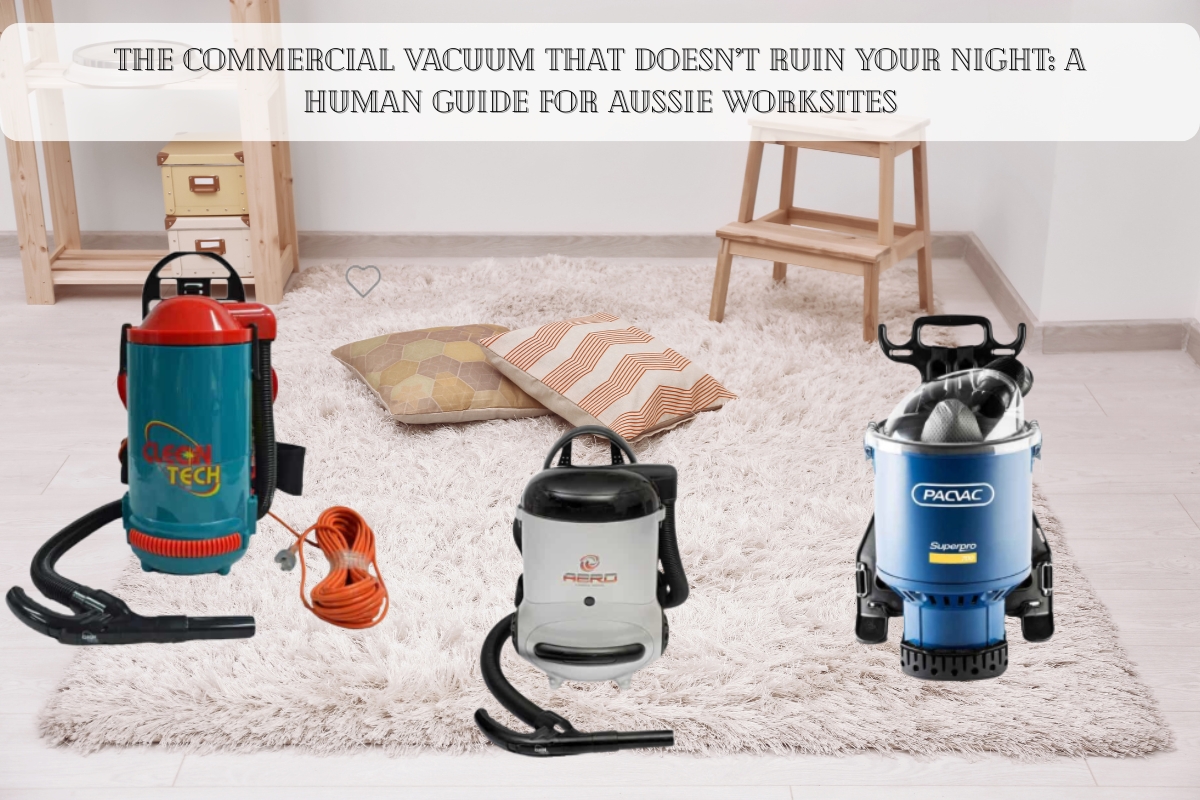
Backpack vacuums: Brilliant when they’re treated properly
Backpacks can absolutely fly through corridors, stairs, and furniture-heavy zones.
But they rely on a basic level of care. If they’re thrown in a ute, hung by the hose, or worn wrong every night, they’ll punish you with split hoses and cracked fittings.
If you’ve got a stable team and repeatable work, backpacks are often a win. If you’re constantly onboarding new staff and time is tight, you need to plan for training and handling.
Wet/dry: great to have, terrible to misuse
Wet/dry units are built for liquids and heavier debris. They’re also often bulkier and louder.
If wet pickup is occasional, many businesses do better with a dedicated wet/dry unit for spill response rather than asking the everyday vacuum to do everything.
Because “doing everything” usually means “wearing out early.”
Filtration: Not a buzzword when fine dust is part of the job
If you deal with fine dust—busy entrances, renovation-adjacent areas, older carpets, high foot traffic—filtration matters.
But it comes with a trade-off: better filtration usually requires better habits. Filters need checking. Bags need changing before they burst. Airflow needs to stay open.
In other words: Filtration is only as good as the routine behind it.
Parts-first thinking: The adult approach to buying vacuums
Here’s the truth that saves the most money:
Vacuum downtime usually isn’t caused by a “major failure.” It’s caused by small parts and consumables.
A hose splits. A filter is clogged. A floor head is worn to nothing. A belt snaps. A latch breaks. Then the machine is “out” and everyone starts borrowing whatever is closest, even if it’s wrong for the job.
The parts that most commonly decide whether a vacuum stays in service are predictable:
- Bags and seals
- Filters and filter media
- Hoses, cuffs, fittings
- Floor tools, brush rolls, belts
- Cords, plugs, and strain relief points
- Wheels, clips, latches
- Motors (often stressed by restricted airflow and dust ingress)
So before you commit, do the boring check that prevents drama later:
If the model is shortlisted, confirm the wear items you’ll replace most often—filters, hoses, floor tools and common fittings—are easy to source using an AC Cleaning Supplies vacuum parts guide.
If that sentence sounds overly sensible, good. Sensible is how you stop losing nights to equipment problems.
Common mistakes (and why they happen)
Most “mistakes” aren’t laziness. They’re under time pressure.
People do what gets the job finished.
So if the system makes it hard to do the right thing, the wrong thing becomes normal.
Overfilling bags and bins
It feels efficient until it isn’t.
Overfilled bags choke airflow, make the motor run hotter, and turn emptying into a dusty mess that nobody wants to deal with. Then people avoid it again, and the cycle continues.
Ignoring the early warning signs
When suction drops, it’s usually not “the vacuum is dead.” It’s:
- A blockage
- A full bag
- A clogged filter
- A worn head/tool
If operators aren’t trained to recognise airflow drop as a signal, they’ll keep pushing until the machine is running hot and unhappy.
Using one vacuum for everything
Fine dust, food debris, wet spills, sharp bits—each behaves differently.
A vacuum that’s forced to do every type of mess will usually fail early, or at the very least become “that vacuum everyone hates.”
Neglecting floor tools and brush rolls
A worn floor head makes a good vacuum feel useless.
Then operators respond by pushing harder and doing extra passes, which increases fatigue and chews up time. The machine gets blamed, but the real issue is often the tool.
DIY repairs where safety matters
Swapping consumables and external parts is normal.
But electrical faults and internal repairs are not a “quick YouTube fix” on a commercial site. Tag it out. Get a qualified technician.
Operator Experience Moment
On real shifts, I’ve watched teams keep using a vacuum that’s clearly struggling because stopping to fix it feels like losing time. The giveaway is that people start doing extra passes and getting quietly frustrated with themselves. Once that happens, the vacuum isn’t just underperforming—it’s stealing labour from everything else on the checklist. A one-minute airflow habit prevents that spiral far more often than buying “the most powerful” model—especially when you can quickly source replacements from a trusted Australian supplier for vacuum parts and servicing.
Local SMB mini-walkthrough (Australia)
A small Australian cleaning business wins a new mixed contract: a medical centre and attached offices.Entry mats load up with grit, and corridor carpet gets hammered daily.They select one vacuum that handles carpet runs well and another option for quick hard-floor touch-ups.They standardise bags and filters across both locations so ordering and restocking stay simple.A weekly check catches blockages early, before suction drops and jobs start blowing out.When a hose splits mid-week, it’s replaced quickly, and the roster stays on track.
Practical Opinions
Prioritise parts availability over fancy features.Standardise consumables across sites whenever possible.Teach airflow checks like brushing teeth—quick, normal, non-negotiable.
Key Takeaways
- Choose equipment based on the real surfaces, mess types, and work patterns at the site.
- Most downtime is caused by predictable wear items, so plan for parts early.
- Airflow issues (bags, filters, blockages) create heat and slow decline—treat them fast.
- Ergonomics and simplicity matter because cleaning happens under time pressure.
- Standardising consumables reduces ordering errors and keeps gear in service.
Common questions we get from Aussie business owners
How often should we check a commercial vacuum?
Usually, a quick daily check is enough to prevent most issues: bag/bin level, hose glance, cord check, and a quick “does it sound normal?” test. A practical next step is to put a one-minute checklist in the storage area and make it part of pack-down. In most cases in Australia, checks stick better when they’re tied to a routine moment—like end-of-shift lock-up.
Do we need HEPA filtration for offices and clinics?
It depends on what kind of dust the site produces and what the cleaning scope expects. A practical next step is to identify whether fine dust is a recurring problem (busy entrances, older carpets, renovation-adjacent zones) and choose filtration accordingly. Usually, in Australian shared indoor spaces, filtration helps most when the team also keeps on top of bags and filters—otherwise, performance drops quickly.
What’s the fastest way to reduce downtime across multiple sites?
In most cases, the quickest win is standardisation: fewer bag types, fewer filter types, fewer fittings that don’t match. A practical next step is to list the two most common failures you see (often hoses and filters) and set a simple “always have one spare” rule. Usually in Australia, crews move between different site types, and standardisation reduces training friction and ordering mistakes.
When should we repair versus replace?
It depends on whether the issue is a straightforward wear-part fix or a sign that the vacuum has been running restricted and overheating for a long time. A practical next step is to look for patterns: repeated suction loss, constant blockages, or ongoing filter problems that suggest deeper wear. In most cases in Australia, repairs make sense when parts are readily available, and the unit has otherwise been reliable, but anything electrical should be handled by a qualified technician.