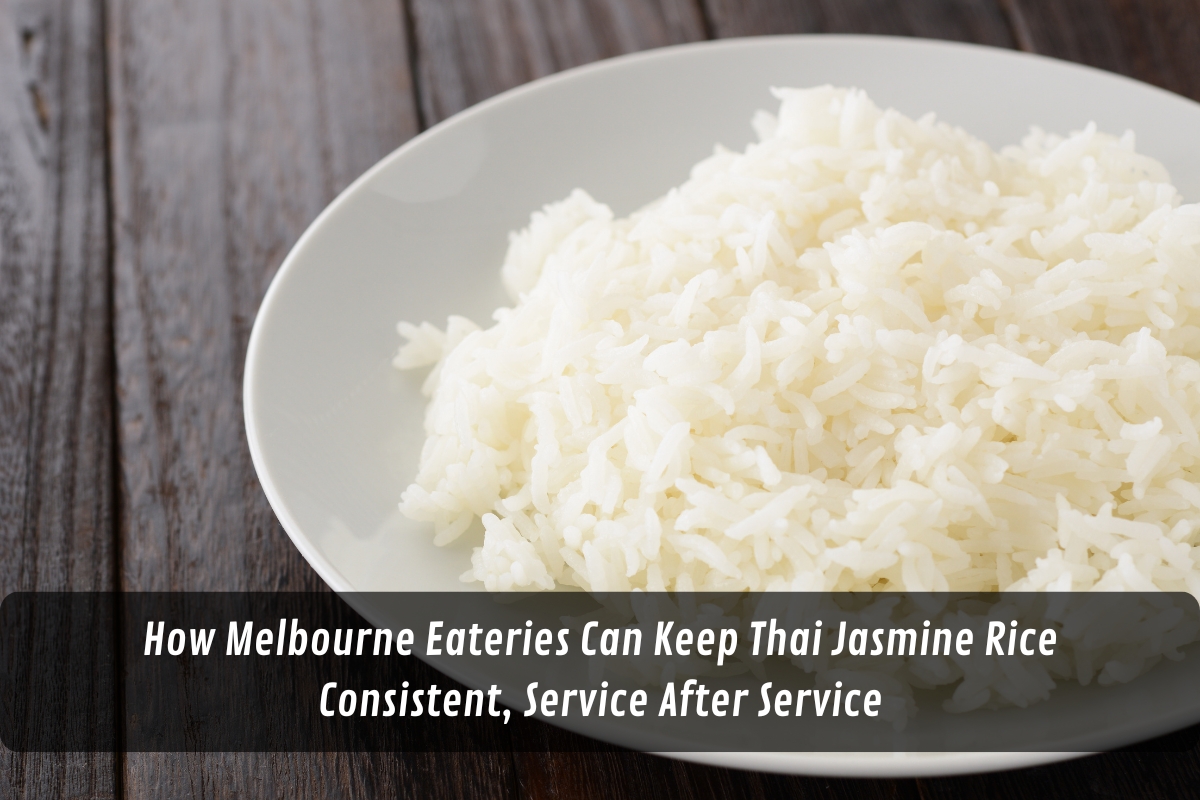
You can usually tell when rice has been treated as an afterthought. It hits the table a bit flat. It clumps. It cools down and turns into one sad sheet. Nobody complains loudly, but people stop noticing the dish for the right reasons.
In Melbourne, where diners clock the details, rice is one of those quiet make-or-break ingredients. It’s not meant to steal the show, but it has to behave: smell right, portion cleanly, hold up through the rush, and taste the same on a Tuesday as it does on a Saturday.
If you’re buying Thai jasmine (fragrant) rice for a venue, the goal isn’t to find “the best bag on earth”. The goal is to stop surprises. This is a human, kitchen-first way to do that—without turning procurement into a science project.
What “consistent rice” actually looks like at 7:18 pm
At home, “good rice” can be vibes-based. You’ve got time. You can tweak. You can shrug.
In a commercial kitchen, consistency is painfully literal. It’s the difference between a smooth service and a slow-motion spiral.
Consistency means:
- The aroma is still there once the rice has rested—not just when the steam first comes off.
- The grains portion cleanly, even after sitting warm for a while.
- Your water ratio doesn’t feel like a guess every new delivery.
- Your cooks don’t have to “save” a batch mid-service.
If that sounds basic, it is. But it’s also the stuff that keeps the pass calm.
The buying decision is rarely about price first
Here’s the honest bit: most venues don’t get stung because they chose a “bad” rice. They get stung because they chose a rice that didn’t match the way they run their service.
A smart buy lines up with real-world kitchen conditions:
- How you cook it (batch size, equipment, rinse habits).
- How you hold it (warmer, hotel pans, covered, uncovered, time).
- How often you reorder (weekly, fortnightly, “when we remember”).
- Where it lives once opened (dry store, under the bench, near the steamer).
If any one of those is messy, rice quality looks messy too.
Decision factors that matter when you’re feeding people at scale
1) “Will it behave the same every time?”You want a rice that cooks predictably and holds predictably. That’s it. That’s the whole show.
2) Aroma and texture that match your menuSome menus want that classic jasmine lift as soon as the lid comes off. Other menus want a quieter base, so the curry, stir-fry, or grilled meat stays the headline.
3) Pack sizes that suit your paceToo small means constant ripping, decanting, and waste. Too large means opened product hanging around long enough to lose punch—or worse, pick up smells.
4) Delivery rhythm you can actually rely onIf you’re buying for Melbourne service, the biggest consistency killer is “we ran out and grabbed whatever we could today”.
5) Total cost per serve (not cost per bag)If your team is re-cooking, adding water midstream, or tossing a pan that went wrong, you’re paying for that.
Practical Opinions (3 lines total):A “solid and consistent” rice usually beats a “fancy but variable” rice.Pick the rice that holds texture through service, not the one that impresses at first sniff.If you can’t depend on delivery, you’ll end up depending on substitutions.
Common mistakes (the ones nobody wants to admit)
These aren’t moral failures. They’re just what happens in busy venues.
Mistake 1: Buying without agreeing on what “good” means.If the buyer says “nice jasmine rice” and the chef hears “strong aroma, fluffy grains, holds for 45 minutes”, you’ll never be aligned. You’re both right—and you’re both annoyed later.
Mistake 2: Switching bags and keeping the same cooking method.Even slight differences in how rice absorbs water can turn “perfect” into “why is this sticky today?”
Mistake 3: Treating opened sacks like they’re invisible.Rice is stable, yes. But jasmine rice’s fragrance is part of what you’re paying for, and it fades faster when a bag is left open near heat, steam, or strong smells.
Mistake 4: Expecting one magic water ratio forever.Venues do better with a baseline ratio plus a quick correction habit—especially when different people cook rice on different shifts.
Mistake 5: Running down to zero and improvising.Improvising rice is like improvising salt. You can do it, but everyone notices.
A kitchen-friendly way to choose jasmine rice (without turning into a spreadsheet person)
You don’t need a lab. You need a simple, repeatable test that matches how you actually serve rice.
Step 1: Write your “service standard” in plain English
Make it one paragraph. Keep it human. For example:
- “We want medium aroma, fluffy grains, and it should hold 45 minutes in the warmer without clumping.”
- “We want subtle fragrance, clean separation, and it needs to reheat without turning gluey.”
That paragraph becomes your anchor. It stops debates like “this one feels nicer” because you’re judging against a real target.
Step 2: Run a three-sample cook test (the only test that matters)
Pick three options. Cook them on the same day. Same equipment, same pot, same process.
Then do the thing most people skip: hold it. Don’t just taste it fresh.
Score each one on:
- Aroma after resting and after holding
- Grain separation when portioning
- Texture at minute 45
- How forgiving it is if someone is slightly heavy-handed with water
The forgiving part matters more than people admit. A rice that’s perfect only when cooked perfectly is a risk in a rotating roster kitchen.
Step 3: Make the pack format and ordering part of the decision
Before you commit, ask: Does this match how we operate?
- Are pack sizes realistic for our weekly usage?
- Do we have the storage to keep the opened product sealed and clean?
- Can we reorder without panic?
If the kitchen team wants a single page to align on grain expectations and pack formats before ordering, the BKK Australia supply guide can help standardise the checklist.
Step 4: Lock the method like it’s a recipe, not a suggestion
Once you choose the rice, give it a fair chance:
- Baseline ratio
- Rest time
- Holding method
- “What to do if it’s too wet / too dry” (quick fixes, not shame)
Then post it where rice gets cooked. If the method lives only in one person’s head, it’s not a method—it’s a superstition.
Operator Experience Moment
There’s a specific kind of kitchen tension that shows up when rice is inconsistent: nobody can prove what changed, but everyone feels it. In my experience, the quickest way to calm that down is to agree on a simple service standard and make the cook-and-hold method visible for every shift. Once that’s done, rice stops being a daily debate and becomes a background win.
Storage: The unglamorous place where jasmine rice wins or loses
If jasmine rice is losing fragrance, the issue is often the corner you’re storing it in—not the brand.
A few habits that save a lot of grief:
- Decant opened rice into sealed, food-grade containers.
- Label with open date so older product doesn’t linger.
- Store away from steam, heat, and strong odours (dishwash zones are notorious).
- Rotate “first opened, first used”.
This isn’t preciousness. It’s protecting what you paid for.
Local SMB mini-walkthrough: How a Melbourne venue makes the call (5–7 lines)
A 70-seat Melbourne eatery looks at weekly covers and sets a rice par that matches reality.They shortlisted two jasmine options that fit their desired aroma and holding time.The head chef runs a three-sample cook test during prep, then holds each batch for 45 minutes.They choose the rice that portions cleanly and stays fluffy under their warmer setup.Opened sacks are decanted, labelled, and stored away from steam and cleaning chemicals.A one-page cook method gets taped near the rice station for every shift.
First action plan: A realistic next 7–14 days
Days 1–2: Decide what you’re aiming forWrite the one-paragraph service standard and confirm how long rice typically sits warm.
Days 3–5: Test as you serveRun the three-sample cook, rest, and hold test. Pick the rice that holds up at minute 45.
Days 6–7: Make the method repeatableDocument the baseline ratio, rest time, holding approach, and quick corrections. Do a short shift briefing.
Days 8–14: Remove the “panic reorder” riskSet a reorder point with a small buffer. Tighten storage. Check consistency after the next delivery.
Key Takeaways
- Consistency comes from matching rice choice to how the kitchen actually cooks and holds it.
- The only test that matters includes holding time—fresh-tasted rice can be misleading.
- Pack size, delivery rhythm, and storage habits are part of “quality” in real service.
- Document the cook-and-hold method so every shift produces the same result.
Common questions we hear from Australian businesses
How do we compare options quickly without getting stuck in analysis?Usually, the fastest path is to write a one-paragraph service standard, then run a three-sample cook test with your real holding method. The next step is to score each option at minute 45, not just right after cooking. In most cases for Australian venues, the holding setup (warmer vs pans, covered vs uncovered) is where differences become obvious.
Should we rinse jasmine rice in a commercial kitchen?It depends on the texture you’re targeting and how your team holds rice during service. The next step is to test one batch rinsed and one not rinsed using the same rice and equipment, then compare portioning and clumping after holding. In most cases in Australian kitchens, the best approach is the one you can standardise across staff without slowing prep.
What pack size should a small group of venues or a single eatery choose?In most cases, you want a pack size that gets used quickly after opening while still reducing handling labour. The next step is to calculate weekly usage from covers and portion sizes, then pick a format that avoids half-open sacks sitting near heat or humidity. Usually, in Australian back-of-house spaces, decanting into sealed containers is the real win regardless of bag size.
How do we avoid last-minute substitutions that change the plate?Usually, the fix is setting a reorder point with a buffer and sticking to it even when it feels “early”. The next step is to track rice usage for two weeks and set par levels based on actual numbers, not gut feel. In most cases across Australia, lead times can shift around public holidays and peak periods, so a small buffer prevents the scramble-buy that breaks consistency.