


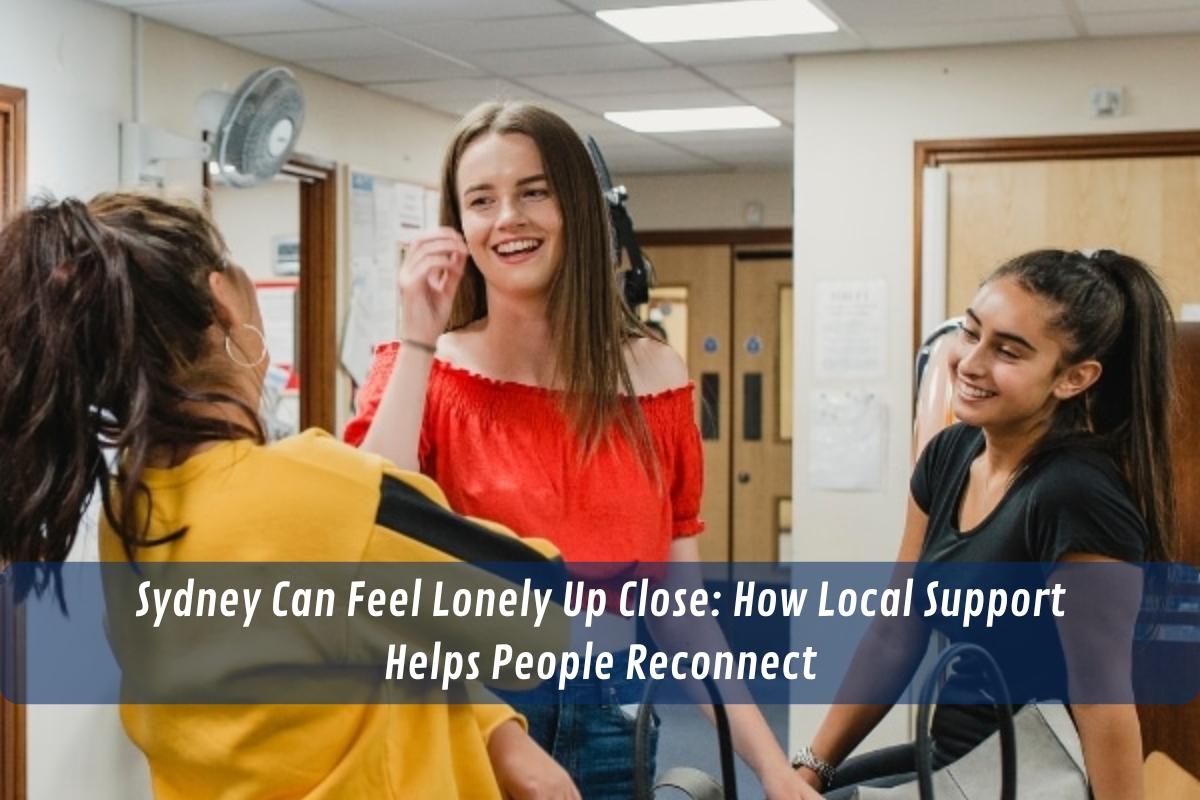
Sydney is full of people, and that’s part of the problem.
You can spend a day surrounded by strangers—on the platform, in the lift, in the supermarket aisle—without a single moment of real contact. Everyone is in motion. Everyone is headed somewhere. The city is loud with life, but it doesn’t always feel like life is reaching you.
For someone who’s been isolated for a while, this can be a peculiar kind of ache. Not always sadness. Sometimes it’s numbness. Sometimes it’s a sense of being slightly out of sync with the world, like everyone else has learned a rhythm you missed.
When people talk about “being more social,” it often comes out as advice. Join a group. Say yes to invitations. Put yourself out there. The words are tidy. The reality isn’t.
In Sydney’s suburbs, social connection has its own set of practical hurdles—distance, transport, sensory overload, fatigue, anxiety, and the sheer effort of planning. And for many people living with disabilities, these aren’t side issues.
Local social connection support is often less about becoming a different person and more about making life feel navigable again. It’s about building the kind of routine where community isn’t an abstract concept. It’s a place you can get to, handle, and return from.
The first step isn’t “confidence”. It’s friction.
A lot of people assume the barrier to connection is shyness. Sometimes it is. Often it’s friction.
Friction is the pile-up of small obstacles that turn a simple outing into a complex project:
- The bus that comes once an hour
- The interchange that always feels too crowded
- The venue that’s louder than expected
- The worry about getting lost, arriving late, or not knowing what to do
- The energy crash that can knock out the rest of the day
Friction is also emotional. If a person has had a few awkward experiences—turning up to something and not knowing where to stand, or trying to join in and feeling ignored—memory does its job. It starts to protect them by steering them away from trying again.
This is why “just do it” is rarely useful. The work, at the beginning, is usually about reducing friction until trying again becomes possible.
Why “local” is not a limitation
There’s a common idea that the real action is elsewhere: the CBD, the big venues, the packed calendars, the places that feel important. But connection isn’t built by importance. It’s built by repetition.
Local participation has quite a few strengths:
- Short travel times mean more energy left for the activity itself
- Familiar streets and landmarks reduce anxiety
- Returning to the same place makes the environment feel less demanding
- Seeing the same faces over time makes conversation easier without forcing it
In many Sydney suburbs, the most meaningful community isn’t flashy. It’s the weekly group in the back room. The regular class. The community garden. The familiar staff at the library. The corner café where someone eventually says, “Oh, hey, you’re back.”
That’s how belonging often starts: not with a grand entrance, but with being recognised.
What “community participation” looks like on an ordinary week
The phrase can sound like paperwork, but the lived version is grounded. It’s support that helps a person get out into the community in a way that makes sense for their goals and their real life.
Sometimes that means finding activities that fit who they are, rather than what looks good on paper. Sometimes it means practising the practical parts—planning, travel, pacing, coping strategies—so participation is sustainable.
It can also mean building social capability gently, without turning every outing into a performance.
For a simple overview of how this kind of support can be structured, see social and community participation (Abundance Healthcare Group).
The “starter activity” should feel more like relief than a challenge
A common mistake is aiming too high too quickly—big groups, loud spaces, long durations, unstructured socialising. If someone is already nervous, that kind of setting can teach the wrong lesson: “I can’t do this.”
The best starter activities usually have three qualities:
Predictable
People do better when they can picture what will happen. A recurring class or group tends to be easier than a one-off event. Predictability lowers the mental load.
Structured
A shared activity reduces pressure. When there’s something to do—cook, paint, walk, sort donations, tend a garden—conversation can emerge naturally. Silence isn’t a failure; it’s just part of the activity.
Short
Thirty minutes to an hour is often enough early on. The point is to leave before the person is depleted, so the memory of the experience stays manageable.
Over time, these small, repeatable experiences teach a nervous system something important: “I can be out, and I can come home okay.”
Transport: The part that decides everything in Sydney
In a city built around distance, transport isn’t just a detail—it can be the entire barrier.
Sometimes the support a person needs isn’t “social coaching.” It’s the practical confidence to get from home to an activity and back without the journey taking everything they’ve got.
A steady approach might involve:
- Mapping a route that avoids the most stressful points
- Practising at quieter times first
- Doing a “trial run” with no expectation of staying long
- Building a backup plan for delays or changes
- Learning how to ask for help when things go off-script
Independence doesn’t have to be all-or-nothing. Being able to do one leg of the journey with less support than before is a meaningful shift. It expands the map of what’s possible.
When anxiety or sensory overload is the real issue
Sometimes the obstacle isn’t social at all. It’s the environment.
Sydney can be intense: bright lighting, unpredictable noise, crowds that move fast, transport that can feel like a sensory assault. For someone who experiences anxiety, panic, or sensory overload, “going out” can become synonymous with bracing.
A more realistic approach often includes:
- Choosing quieter venues or off-peak times
- Keeping early outings intentionally brief
- Having a clear arrival/exit plan
- Identifying early signs of overwhelm
- Building recovery time into the day on purpose
This isn’t avoidance. It’s pacing. It’s the difference between a single outing that wipes someone out for days and a routine they can repeat weekly.
What good support feels like
From the outside, “community participation” can look like someone going to an activity. From the inside, the quality is in how it feels.
The most helpful support often has a particular flavour:
- It’s collaborative, not pushy
- It treats dignity as non-negotiable
- It respects that “no” might mean “not yet”
- It focuses on steady progress, not quick wins
- It builds skills quietly—planning, boundaries, communication, self-advocacy
The aim isn’t to manufacture a social life. It’s to help a person build a version of connection that’s genuine and sustainable.
Key Takeaways
- In Sydney, the biggest barrier to social connection is often practical “friction,” not a lack of desire.
- Local, suburb-based routines reduce travel strain and make repetition more realistic.
- The best starter activities are predictable, structured, and short—so early experiences stay manageable.
- Transport confidence and sensory pacing can be central to sustainable participation.
- Progress is usually subtle at first; consistency is what turns outings into belonging.