


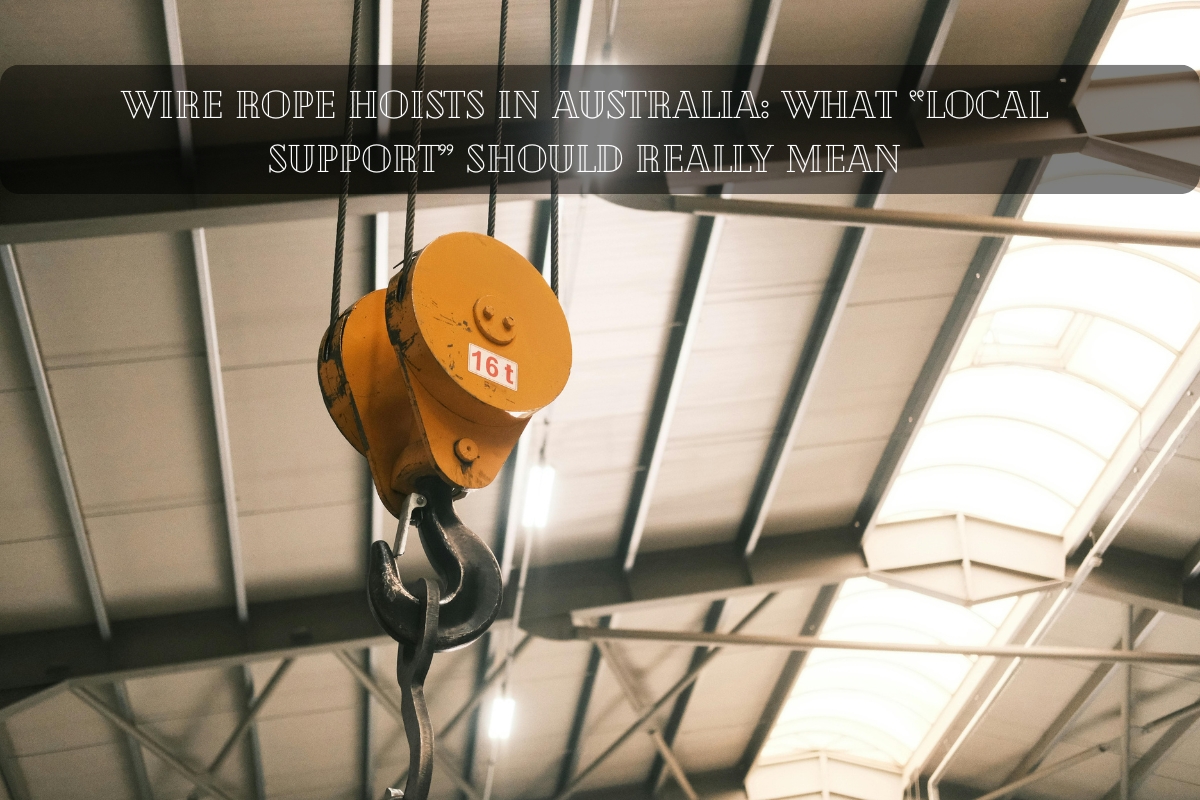
A wire rope hoist is rarely a “set-and-forget” purchase or hire. It’s a piece of lifting equipment that sits right in the middle of productivity and risk: if it’s under-specced, poorly installed, hard to service, or mismatched to the way a site actually works, the costs show up fast—delays, rework, and unnecessary manual handling.
That’s why the best outcomes often come down to the supplier as much as the hoist itself. In Australia, “local” can mean a lot of things: a supplier with a nearby depot, a business that can get a technician to the site, or simply a team that understands the realities of local construction programs, access constraints, and compliance expectations. If you’re sourcing across multiple states, it can also mean consistent support and documentation wherever the job is.
Below is what to look for when choosing a local wire rope hoist supplier across Australia—and how to sanity-check the match before you commit.
Start with the lift plan, not the brand
Most hoist problems start upstream: the load, the lift height, the duty cycle, and the mounting method weren’t fully considered at the beginning.
A capable supplier should be able to help you translate “we need to get materials up there” into practical inputs such as:
- What’s being lifted (and how it’s packaged): Palletised material behaves differently from long or flexible loads.
- True weight range: Including containers, stillage, rigging, and any handling frames.
- Lift height and travel path: Straight vertical lifts are simpler than lifts with offsets, setbacks, or tight landings.
- Duty cycle and speed expectations: “A few lifts a day” vs “constant cycling during peak trades” changes everything.
- Power and cable routing: The safest plan is the one that doesn’t rely on improvised leads and exposed runs.
If the supplier is only talking model numbers early on, that’s a sign you may be driving the specification alone—fine for experienced rigging teams, but a risk for mixed-skill crews or complicated sites.
The real difference is support: Setup, servicing, and spares
Two hoists with similar capacity on paper can create very different site experiences. The gap often comes down to the supplier’s support model.
Set up and handover that matches the site reality
A hoist is only as safe as its installation and operation. Local support matters when the site changes—as it always does.
Look for a supplier that can provide:
- Practical setup guidance aligned with your mounting method (scaffold, slab edge, roof zone, purpose-built point, etc.).
- Clear handover on controls, exclusion zones, and day-to-day checks.
- Documentation you can file for onboarding and internal WHS processes.
Even if your team is competent, a clean handover reduces “telephone game” mistakes between shifts and subcontractors.
Servicing and turnaround
Ask what happens if something fails mid-program. Not in theory—in practice:
- Is there a swap-out process?
- Are common wear items readily available?
- Is there a realistic pathway to get advice quickly when a site needs to adapt?
Australia-wide projects amplify these questions. Freight and distance can turn a small fault into a multi-day delay if the supplier doesn’t have a plan for support beyond one city.
“Local” in Sydney isn’t the same as “Australia-wide”—and that’s okay
Many projects start with a genuinely local need: a Sydney job that needs a hoist quickly, with delivery coordination that respects access windows, tight blocks, and site rules. That kind of proximity is valuable.
But if your scope spans multiple states (or you routinely mobilise teams interstate), “local” should also mean:
- Consistent specifications and paperwork across sites
- Predictable availability (or transparent lead times)
- A support network that can coordinate logistics beyond one metro area
The right supplier doesn’t need to claim a depot in every city to be useful nationally—but they should be clear about what coverage looks like, and how they handle interstate delivery, returns, inspections, and troubleshooting.
A checklist of questions worth asking before you commit
You don’t need a 40-page procurement process to avoid common hoist mistakes. These questions will surface whether the supplier understands the job:
- What information do you need from us to recommend the right configuration?If they don’t ask about lift height, load type, duty cycle, mounting, and power, expect gaps later.
- How do you confirm the mounting method is suitable?This isn’t about engineering sign-off in an editorial sense—rather, it’s about whether the supplier has a process to check clearances and practical workflow.
- What’s included in the supply/hire package?Controls, standard rope/cable configuration, any mounting accessories, and handover expectations should be clearly scoped.
- What are the operator expectations and site controls?A good supplier will talk about exclusion zones, visibility, and safe standing positions—because these are where incidents happen.
- What’s your plan if the site needs to change?Programs shift. Deliveries move. Access changes. Ask how flexible the supplier can be without introducing unsafe “quick fixes”.
Wire rope hoist selection: A few practical watch-outs
Even when the supplier is strong, it helps to know the common traps.
Underestimating real loads
Many sites think in “material weight” and forget the rest—pallets, stillages, rigging gear, wet materials, and accumulated debris. A supplier should encourage conservative assumptions.
Focusing on max capacity and ignoring duty cycle
A hoist that can lift the load once doesn’t necessarily suit repetitive use across a full shift. Duty cycle and thermal limits are where performance mismatches show up.
Ignoring access and landing zones
The lift is only half the task. Where does the load go at the top? Is there a safe zone to receive it? Are there hand-off points that encourage awkward manual handling?
Treating controls as an afterthought
Simple improvements—control placement, clear sightlines, safe operator positions—can reduce near-misses and improve flow on busy sites.
Where to see typical rope hoist configurations (and what to compare)
If you’re trying to compare what a site-focused supplier typically provides—such as practical guidance around lift height, load type, mounting options, and how hire/supply is scoped—it can help to look at a concrete example of how rope hoist options are presented for worksites. One reference point is this overview of rope hoist options and configurations (CH Hoists).
Use any example like this as a prompt for your own due diligence: does the supplier explain how to match equipment to site constraints, and do they set clear expectations about what’s included, what’s site-dependent, and what requires qualified confirmation?
Key Takeaways
- A wire rope hoist supplier should help translate your lift plan into the right configuration—capacity alone isn’t enough.
- “Local support” matters most in setup, handover, servicing, and how problems are handled mid-program.
- For multi-state work, look for consistent documentation and a realistic logistics/support plan, not vague coverage claims.
- Ask direct questions about mounting checks, inclusions, change management, and fault response before committing.
- The best supplier is the one that reduces manual handling and uncertainty on site—without overcomplicating the job.