


There’s a particular kind of postponement that business owners are very good at. It sounds like this: “Not this month. Maybe after the next busy stretch.”
Dental issues live in that category more than almost anything else.
A missing or failing tooth doesn’t usually explode overnight. It lingers, nags, adapts, and lets you convince yourself it’s manageable—right up until it starts running your calendar.
If you’re in retail, food service, or any customer-facing role, the impact isn’t just physical. It’s how you chew during a 10-hour shift, how clearly you speak over noise, how confidently you greet customers, or how willing you are to jump into photos or presentations.
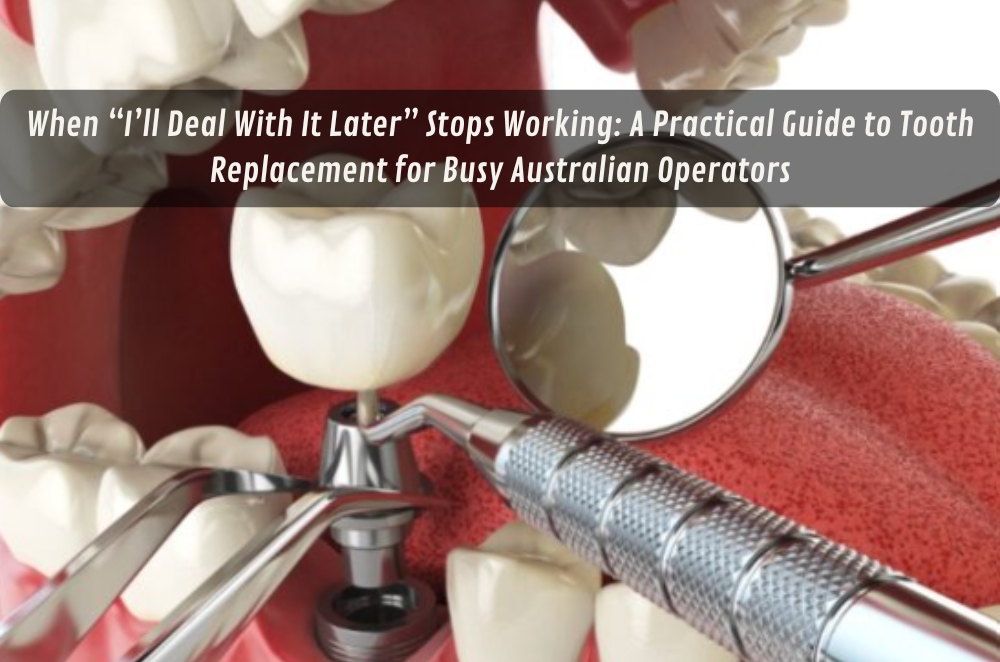
For many business owners, exploring options like an implant supported replacement for missing teeth becomes less about appearance and more about restoring consistency to daily life.
This isn’t about aesthetics. It’s about predictability, energy, and not structuring your business around something that keeps threatening to derail it.
The real cost isn’t the appointment — it’s the unpredictability
Most operators can handle a scheduled appointment. What’s harder is the uncertainty.
Will it flare up before the Saturday trade? Will a temporary fix hold through a double shift? Will recovery take longer than expected?
Uncertainty forces you into defensive scheduling. You overcompensate, shuffle shifts, avoid committing to events, and mentally keep one eye on a problem you “haven’t had time” to fix properly.
That’s when it stops being a dental issue and starts being an operational one.
Common mistakes busy Australians make
1) Treating a stopgap as a strategy. Temporary solutions are sometimes necessary, but they’re not a long-term plan unless you consciously decide they are.
2) Choosing based on speed alone. Fast can be fine. But fast without understanding maintenance and follow-up is just borrowing stress from the future.
3) Avoiding the constraint conversation. Suitability matters. Bone health, gum condition, medical history, smoking status, bite force — these aren’t minor details. They shape what’s realistic.
4) Comparing prices instead of comparing disruption.The better question is: Which option will demand less unscheduled attention over the next two years?
5) Waiting for “the perfect time. ”There isn’t one. There’s only planned or reactive.
Decision factors that actually move the needle
When people ask, “What’s the best option?” they usually mean, “What’s the most advanced?”
That’s not the right frame.
The better frame is: What aligns with my health, my timeline, and my ability to maintain it?
Fixed vs removable — how hands-on do you want to be?
Some solutions are removable and may involve more day-to-day management. Others are fixed in place and, for many people, feel closer to natural teeth.
Neither is automatically superior. The question is how much involvement you realistically want long-term.
If you’re already stretched thin, low-maintenance may matter more than novelty.
What changes permanently?
Some options involve neighbouring teeth. Others are designed to replace what’s missing without relying on adjacent teeth.
You want this explained clearly. “What are we altering, and what happens if something fails?” is a fair question.
Staging and time commitment
Many treatment paths are staged. Assessment, possible preparatory work, main procedure, and review appointments.
A transparent provider will outline this upfront. That clarity lets you plan around peak trading periods instead of scrambling.
Total cost over time
Upfront cost is visible. Maintenance, adjustments, or future replacements are less obvious.
Long-term durability depends on individual health and habits, so the honest conversation isn’t about guarantees — it’s about likelihoods and responsibilities.
Suitability and trade-offs
This is where responsible providers separate themselves.
If you’re considering a longer-term fixed solution, reading a plain-language overview like the Blue Mountains Dental & Implant Centre treatment guide before your consult can help you walk in with better questions.
The goal isn’t to self-diagnose. It’s to understand what variables matter so the discussion feels collaborative instead of overwhelming.
Choosing a provider without feeling pressured
You don’t need charisma. You need clarity.
A strong consultation should:
- Outline multiple viable options (if they exist)
- Explain risks and constraints early
- Provide a written staged plan
- Detail aftercare expectations
- Avoid vague promises
If everything sounds effortless and universally suitable, that’s not reassurance — it’s oversimplification.
Operator Experience Moment
I once spoke with a hospitality owner who had been “coping” with a broken tooth for nearly a year.
He’d planned around it constantly — avoiding certain foods during tastings, declining media photos, shifting meetings on days it felt worse.
What finally pushed him to act wasn’t pain. It was realising he was structuring his business life around something he kept pretending was minor.
Once he had a staged plan mapped against his calendar, it stopped feeling dramatic. It felt procedural.
That shift — from emotional avoidance to structured decision — is often the turning point.
Local SMB mini-walkthrough (Australia-wide)
A regional retail manager loses a molar but keeps delaying proper assessment.
School holiday trade ramps up, and she’s covering extra shifts.
Temporary fixes start failing during longer days.
She starts researching tooth implant options for North Sydney residents and blocks two weekday mornings after the rush for a full consult, requesting a written staged plan.
She aligns the main appointment outside EOFY pressure and assigns a second-in-command for those dates.
Follow-up visits are pre-booked to avoid reactive scheduling.
The issue moves from “constant background stress” to a scheduled project with an endpoint.
Practical Opinions (exactly 3 lines)
If a provider avoids discussing limitations, that’s a red flag. Predictability beats speed in almost every SME scenario. A clear, staged plan is more valuable than persuasive language.
A 7–14 Day Action Plan That Keeps It Practical
Days 1–2: Define the real impact. Write down how the issue affects eating, speaking, confidence, or energy at work. Clarity reduces minimisation.
Days 3–4: Map your operational constraints. List peak periods, key deliveries, major events, and times you can’t realistically step away. This becomes your planning guardrail.
Days 5–7: Book an assessment consult. Ask for a staged plan and realistic timeframes. Bring medical history and medication details so the discussion is complete.
Days 8–10: Compare based on lifestyle fit. For each option, note visits required, recovery expectations, maintenance, and follow-up frequency. If unsure, a second opinion focused on staging—not persuasion—can add clarity.
Days 11–14: Lock in continuity planning. Block appointment times early. Inform key staff. Treat it like any other operational commitment.
Handled this way, it becomes a managed project rather than a background worry.
Key Takeaways
- Tooth replacement decisions are operational decisions as much as health ones.
- Evaluate disruption, maintenance, and staging — not just price or speed.
- A transparent consult should include constraints and aftercare details.
- Within two weeks, you can move from avoidance to a structured plan.
Common questions we hear from Australian businesses
Is it better to act early or wait until it becomes uncomfortable?Usually, earlier assessment provides more options and reduces the chance of reactive disruption. A practical next step is booking a consult now, even if treatment is staged later. In Australia’s seasonal retail cycles, planning around known busy periods is far easier than reacting mid-peak.
How disruptive are staged treatments in practice? It depends on the individual plan, overall health, and complexity. A practical next step is asking for a written outline of visits and recovery expectations before committing. For Australian SMEs, even small scheduling clarity can prevent significant roster strain.
Are longer-term fixed options suitable for everyone? In most cases, suitability depends on gum and bone health, medical history, and lifestyle factors. A practical next step is to undergo a thorough assessment rather than assume eligibility. Australian clinicians typically prioritise conservative evaluation before recommending advanced solutions.
How do we support staff navigating treatment? Usually, clarity reduces anxiety more than reassurance alone. A practical next step is encouraging early communication about appointments and building them into the roster proactively.In many Australian workplaces, structured scheduling support makes follow-through far more likely.