


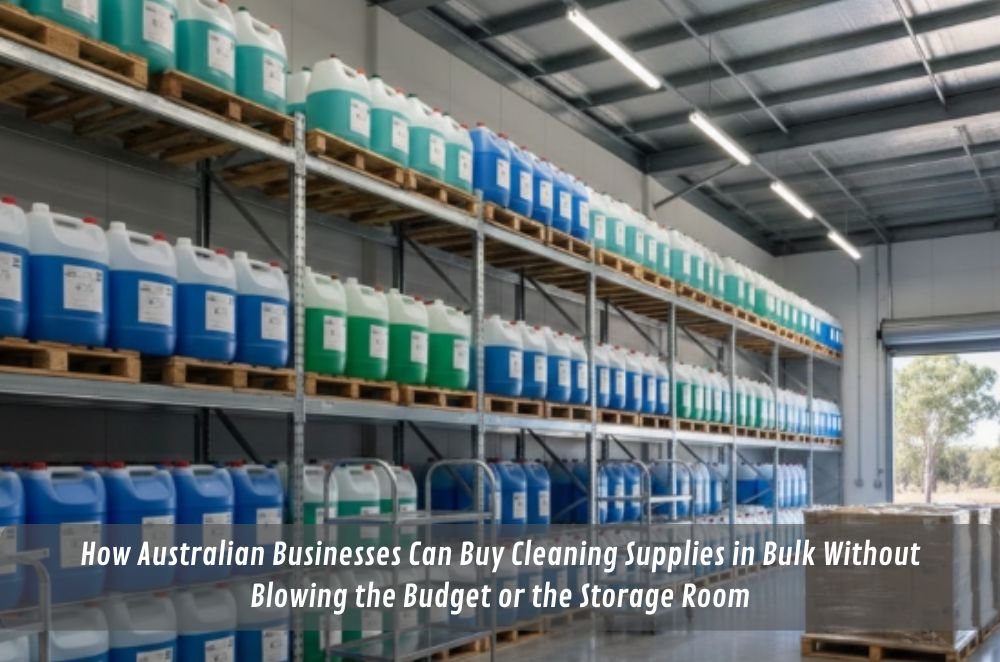
Buying in bulk sounds simple: bigger cartons, lower unit price, fewer invoices.In real workplaces, bulk purchasing can quietly create new problems—blocked storerooms, expired chemicals, inconsistent product use, and “mystery spend” when teams bypass the approved list.
The goal isn’t to buy more.The goal is to buy right: standardise what gets used, control how fast it gets used, and keep supply predictable across sites and shifts.
This guide breaks down a practical approach for Australian businesses that rely on commercial-grade cleaning consumables—cleaning contractors, offices, hospitality venues, medical centres, and public-facing facilities—without assuming perfect storage, perfect staff training, or perfect forecasting.
Why bulk buying fails in real workplaces
Bulk buying fails when it’s treated as a one-off bargain hunt rather than an operating system.
Most workplaces don’t have one person using one product in one room.They have multiple teams, variable foot traffic, and different standards across areas like kitchens, bathrooms, reception, and clinical or staff zones.
Bulk buying also breaks when storage is treated as “free.”A storeroom that’s overflowing slows down staff, increases damage and spills, and encourages ad hoc substitutions when the “right” item can’t be found fast.
Finally, bulk buying fails when the business confuses unit price with total cost.If a cheaper product needs more dosage, more rework, or more time, it’s not actually cheaper.
The real cost drivers behind bulk orders
If the only metric is dollars per carton, the wrong products often win.A better model uses three cost drivers: usage rate, labour friction, and waste.
Usage rate is how fast a SKU disappears in normal conditions.High-usage items—hand towels, toilet paper, bin liners, dishwashing and surface cleaners—are the safest place to bulk-buy because the stock turns over reliably.
Labour friction is the hidden cost of hard-to-use products.A product that foams badly, needs constant dilution, clogs dispensers, or tears easily can add minutes to every shift.
Waste comes from expiry, damage, theft, or “we didn’t know we already had it.”Waste spikes when businesses buy too many variations of the same item, or when stock isn’t labelled and rotated.
A bulk strategy should reward SKUs that reduce handling and rework, not just those with a lower sticker price.
Build a simple SKU strategy that scales
Bulk purchasing works best when the SKU list is small and disciplined.
Start by separating consumables into three tiers:
Tier 1: Always-on essentialsThese are stable, high-usage items that almost every site uses every week (paper, liners, core chemicals, gloves).
Tier 2: Site-specific add-onsThese vary by facility type (hospitality kitchens, showers/locker rooms, workshops, high-traffic foyers).
Tier 3: Speciality or “break glass” itemsThese are used occasionally (spill kits, niche solvents, one-off restoration products) and should rarely be stocked in bulk.
A compact Tier 1 list should be the same across sites where possible.Standardisation makes training easier, reduces purchasing errors, and lets you negotiate service levels around a predictable basket.
A quick way to decide what belongs in Tier 1
Use a simple rule: if the item is used by more than one team and you can reasonably forecast monthly usage, it’s a Tier 1 candidate.
If the item is used only by one person or one room, it probably belongs in Tier 2.If you can’t forecast it without guessing, it belongs in Tier 3.
This is less about being strict and more about making sure the bulk program is built on what’s actually repeatable.
Storage, safety, and compliance basics that prevent expensive mistakes
Bulk buying creates responsibility: you’re storing more product, often for longer, sometimes across multiple locations.
For chemicals, the basics matter.Follow the product label and safety guidance, keep incompatible products separated, and ensure staff know the correct dilution and handling method for what’s onsite.
For paper and consumables, moisture and handling are the enemies.A pallet that sits on a damp floor or gets crushed by stacked cartons turns “savings” into write-offs.
Stock rotation is the overlooked skill that keeps bulk purchasing honest.Label deliveries with received dates, keep older cartons at the front, and avoid half-open cartons scattered across rooms.
If your workplace includes clinical or higher-risk environments, keep language and processes aligned with local requirements and manufacturer directions.In those settings, consistency and documentation often matter more than chasing the lowest unit price.
Decision factors when choosing a bulk-buy approach or supplier
A bulk program is only as good as the system around it.When evaluating how to buy—and who to buy from—focus on the operational details that reduce day-to-day friction.
Range discipline and substitutionsCan the supplier help keep a stable SKU list, or will teams face constant replacements that break dispenser compatibility and training?
Pack sizing that matches realityA mega-carton might suit a high-traffic venue, but it can overload a small office storeroom and cause damage or hoarding at the point of use.
Delivery reliability and cut-off timesFor multi-site operators, predictable delivery windows are often worth more than minor unit-price differences.
Account controls and approvalsCan you separate “approved essentials” from “special request” items so one urgent need doesn’t blow up the entire monthly spend?
Support for standardisationDoes the supplier make it easy to align products across sites, with clear naming, consistent pack sizes, and fewer near-duplicates?
Once the core SKUs and reorder triggers are set, the AC Cleaning Supplies bulk ordering guide is a practical reference for turning that plan into a repeatable order routine.
Common mistakes that quietly kill savings
Buying too many variants of the same productThree similar surface cleaners and two glove types often create confusion, not choice.
Over-ordering to “avoid running out”Without usage tracking, over-ordering just shifts the problem from shortages to waste and clutter.
Ignoring dispenser and equipment compatibilityChanging paper or chemical formats can break dispensers, increase jams, and frustrate staff into workarounds.
Not setting minimums and maximums per siteA bulk program needs boundaries: how low can stock go before reordering, and how high should it ever go?
Treating storerooms as unownedIf no one owns a stock organisation and rotation, bulk buying becomes a monthly argument instead of a system.
Letting urgent purchases set the standardOne emergency order can introduce random SKUs that never leave the building, slowly bloating the “approved” list.
Operator Experience Moment
In day-to-day operations, the biggest “aha” is how quickly product variety creates labour waste.When teams can’t instantly recognise the right item, they either overuse it, substitute it, or ask someone else—each one adding minutes that never show up on an invoice.The turning point is usually a smaller, clearer Tier 1 list and a storeroom layout that makes the correct choice the easy choice.
Local SMB mini-walkthrough: A practical example in Australia
A four-site operator (office + small hospitality venue + two service locations) starts with a messy supply cupboard and unpredictable monthly spend.They list the top 20 items by frequency of purchase and group them into Tier 1, Tier 2, and Tier 3.They standardise one paper towel format and one bin liner spec across all sites to reduce substitutions.They set a basic reorder point per site (two cartons on hand triggers a reorder) and a maximum (no more than six cartons stored).They label shelves, date incoming cartons, and move older stock forward every delivery day.They review the first month’s usage, then remove duplicate SKUs and lock the essentials list for the next quarter.
Practical Opinions
Prefer fewer SKUs over lower unit prices when teams or sites are growing.If storage is tight, buy “often” instead of “huge” and protect cash flow.Measure what gets used, not what gets purchased.
Next 7–14 days: A simple first-action plan
Days 1–2: Map usage and pain pointsList every cleaning consumable and chemical currently stocked, even if it’s “just one bottle.”
Days 3–4: Create the Tier 1 essentials listPick a short set of products that cover the majority of use across sites.
Days 5–6: Set reorder points and maximumsDecide what “too low” and “too much” look like for each essential item, per site.
Days 7–9: Fix storeroom flowLabel shelves by category, keep older stock at the front, and create one location for open cartons.
Days 10–14: Lock the system and reviewRun one reorder cycle, note substitutions and shortages, then adjust only the reorder points—not the entire SKU list.
Key Takeaways
- Bulk buying works when the SKU list is disciplined and tied to real usage, not one-off deals.
- Unit price is only one lever; labour friction and waste often cost more.
- Standardisation across sites reduces errors, speeds training, and improves stock control.
- Reorder points and storeroom ownership turn “bulk” into a repeatable system.
Common questions we hear from Australian businesses
How do you decide what to buy in bulk versus what to buy as needed?Usually, the safest bulk items are those with consistent weekly usage—paper products, liners, core chemicals, and gloves. A practical next step is to label items used every week as Tier 1 and set a basic reorder point per site. In Australia, multi-site operators often find that standardising paper formats first delivers the quickest reduction in purchasing noise.
What if different sites or departments insist they need different products?It depends on whether the difference is operational (equipment/dispensers, surfaces, compliance requirements) or preference. A practical next step is to run a short trial where one standard SKU is used across two sites, then compare rework and staff complaints. In most Australian workplaces, a small number of justified exceptions is fine—what causes trouble is untracked variation.
How can a business prevent bulk stock from expiring or getting wasted?In most cases, the fix is rotation plus maximum stock limits, not more buying rules. A practical next step is to date-label incoming cartons and assign one person per site to do a five-minute “front-face” check on delivery day. In Australia, where storage conditions vary widely (especially in older buildings), keeping paper dry and chemicals correctly stored prevents avoidable write-offs.
Is buying bigger cartons always cheaper overall?Usually, bigger cartons reduce unit price, but they can increase hidden costs if storage is tight or usage is inconsistent. A practical next step is to compare two pack sizes over one month and track how much ends up damaged, misplaced, or overused. In most cases, Australian SMEs benefit from a “right-sized bulk” approach—enough volume to reduce admin, not so much that it becomes clutter and waste.