A Strategic Leap Beyond the Echo Ecosystem
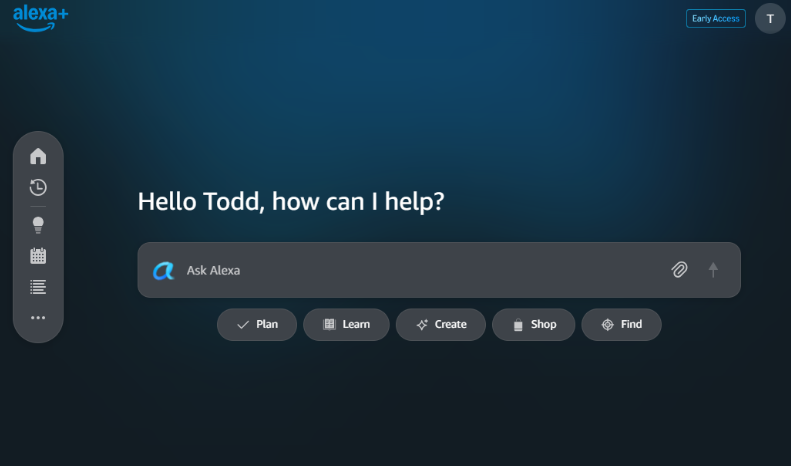
Amazon has taken a decisive step in reshaping the future of its digital assistant by bringing Alexa+ directly to the web. With the launch of Alexa.com, the company is no longer confining Alexa’s intelligence to smart speakers, displays, or mobile apps. Instead, it is positioning Alexa+ as a full-fledged, browser-based artificial intelligence assistant capable of competing head-to-head with leading generative AI platforms. This move reflects a broader recognition that the center of gravity for AI usage has shifted toward web-based interfaces, where users research, plan, create, and make decisions.
For years, Alexa’s identity has been deeply intertwined with voice-first interactions. While this helped Amazon dominate the smart speaker market, it also placed natural limits on how deeply users could engage with the assistant. Complex reasoning, long-form writing, multi-step planning, and research-heavy tasks are simply more efficient when handled through text and visual interfaces. By expanding Alexa+ to the web, Amazon is acknowledging that voice alone is no longer sufficient to meet modern expectations for artificial intelligence.
This expansion is not merely a convenience feature. It is a structural change that allows Alexa+ to exist wherever users already spend their digital lives. Whether at a desktop computer during work hours, on a laptop while planning a trip, or on a shared family device, Alexa.com enables continuous access without requiring dedicated hardware. This repositions Alexa+ from being a household tool to becoming a universal assistant.
Alexa.com and the Reinvention of Accessibility
The launch of Alexa.com introduces a new access model for Amazon’s AI ambitions. Initially restricted to Alexa+ Early Access users, the platform is set to become available to all Amazon Prime members once the early access period concludes. This approach reinforces Amazon’s strategy of using Prime as a gateway to advanced services, increasing the value of membership while encouraging deeper ecosystem engagement. For users outside Prime, a standalone monthly subscription provides an alternative path, signaling Amazon’s confidence that Alexa+ can stand on its own as a paid AI service.
The browser-based experience allows users to interact with Alexa+ through typed input, visual responses, and structured outputs. Tasks that once felt cumbersome through voice commands—such as drafting content, comparing options, or exploring complex subjects—become more intuitive and efficient. The web interface also makes Alexa+ more accessible in professional and academic environments, where voice interaction may be impractical or inappropriate.
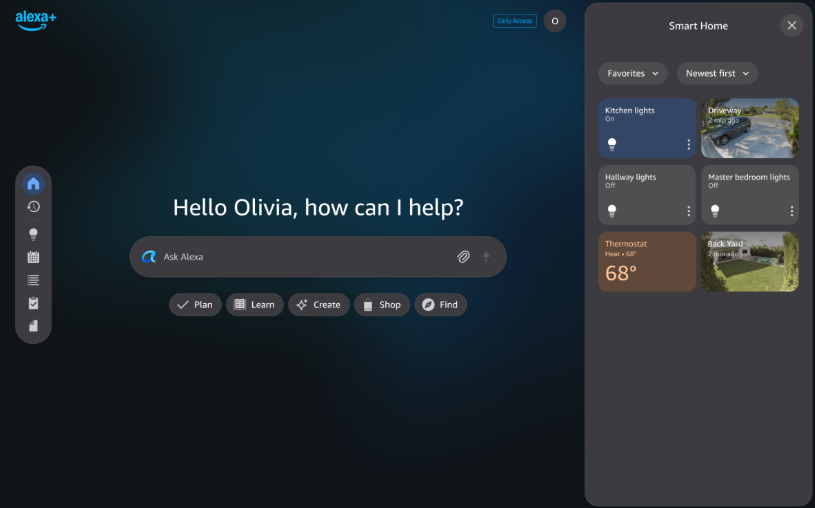
Beyond accessibility, Alexa.com represents a unification of interfaces. Users are no longer tied to a single device or mode of interaction. Instead, Alexa+ becomes a persistent presence that adapts to context, enabling a seamless transition from web-based research to voice-driven execution on smart home devices. This fluidity is critical in a world where users expect continuity across platforms rather than fragmented experiences.
Persistent Intelligence and Cross-Device Continuity
One of the most significant aspects of Alexa+ on the web is its emphasis on persistent context. The assistant is designed to remember previous interactions, preferences, and ongoing tasks regardless of where the user engages with it. A conversation started on a laptop can be resumed on a phone or completed through a smart speaker without losing momentum. This continuity transforms Alexa+ from a reactive tool into a coherent, long-term assistant.
Persistent context enables more meaningful personalization. Over time, Alexa+ can adapt to individual habits, scheduling patterns, household routines, and content preferences. This allows it to offer proactive suggestions and anticipate needs rather than simply responding to commands. In a browser-based environment, this intelligence becomes more visible and actionable, as users can review, edit, and refine Alexa’s outputs in real time.
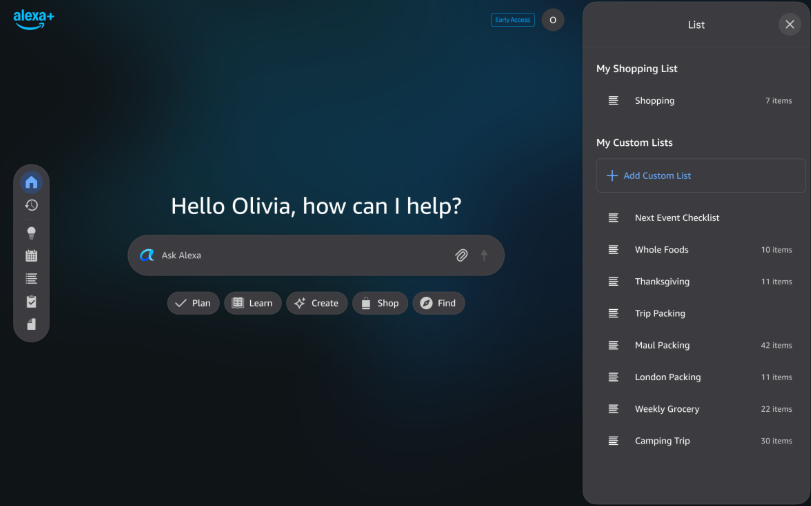
The ability to maintain continuity also strengthens Alexa+ as a family-oriented assistant. Shared calendars, to-do lists, reminders, and smart home controls benefit from a centralized intelligence layer that understands household dynamics. By extending this capability to the web, Amazon ensures that family coordination is not limited to shared devices in the home but can be managed from anywhere.
From Answers to Actions: The Rise of Agentic Alexa
Alexa+ on the web signals a clear shift from passive information delivery toward agentic artificial intelligence. Rather than simply answering questions, the assistant is increasingly capable of executing multi-step workflows. Planning a trip, organizing schedules, managing household logistics, and coordinating tasks all become integrated processes rather than isolated commands.
The browser interface plays a critical role in enabling this evolution. Complex workflows often require reviewing options, adjusting parameters, and making informed choices. Text-based interaction allows users to see the logic behind Alexa’s recommendations, modify plans, and confirm actions before execution. This transparency builds trust while expanding the scope of what the assistant can handle.
Agentic capabilities also highlight Amazon’s unique strengths. Alexa+ can bridge the gap between planning and execution by directly interacting with Amazon’s commerce, logistics, and smart home infrastructure. Tasks such as building shopping lists, managing deliveries, coordinating home automation, and integrating entertainment services can be handled within a single workflow. This level of integration transforms Alexa+ into a central command hub rather than a standalone chatbot.
Competing in a Crowded AI Landscape
The decision to bring Alexa+ to the web places Amazon squarely in direct competition with other leading AI platforms that already dominate browser-based interactions. This move eliminates the protective buffer that once separated Alexa within its own device ecosystem. Now, users can compare Alexa+ side by side with other AI assistants, evaluating them based on speed, reasoning quality, creativity, and task completion.
This competitive exposure raises the stakes for Amazon. Success will depend not only on conversational intelligence but also on reliability, depth, and follow-through. In a browser environment, users expect AI to handle sustained interactions, complex requests, and iterative refinement. Alexa+ must demonstrate that it can meet these expectations consistently.
At the same time, Amazon’s scale provides a powerful advantage. With hundreds of millions of Alexa-enabled devices already in circulation, the company has an established user base that can be funneled into the web experience. Familiarity lowers adoption barriers, while ecosystem integration offers practical benefits that generic AI tools cannot easily replicate. This combination gives Alexa+ a credible path to relevance despite intense competition.
Redefining Productivity and Daily Life Integration
Alexa’s evolution reflects a broader shift in how AI is woven into everyday life. The assistant is no longer confined to controlling lights or setting timers. With web access, Alexa+ becomes a productivity tool capable of supporting work tasks, educational activities, and long-term planning. Homework assistance, content creation, research synthesis, and organizational support all fall within its expanding capabilities.
This transformation blurs the line between personal and professional use. Alexa+ can assist with household management in the morning, support work-related tasks during the day, and help plan personal activities in the evening—all through the same interface. The browser-based model supports this versatility by accommodating both casual and intensive usage patterns.
The emphasis on seamless experience is particularly important. Users increasingly expect technology to fade into the background, enabling outcomes without friction. Alexa+ on the web aims to deliver this by providing a consistent experience across devices, minimizing setup complexity, and reducing the need to switch between multiple tools. If successful, this approach could redefine expectations for what a digital assistant should be.
Long-Term Implications for Amazon’s AI Vision
The launch of Alexa.com represents more than a feature update; it signals a long-term commitment to artificial intelligence as a core pillar of Amazon’s strategy. While immediate financial impact may be limited, the move lays the groundwork for future monetization opportunities tied to commerce, subscriptions, and ecosystem services. As users grow accustomed to relying on Alexa+ for planning and execution, opportunities emerge to integrate shopping, services, and automation more deeply into daily routines.
Over time, Alexa+ could become a central interface for managing digital and physical life. Its value lies not only in intelligence but in orchestration—the ability to coordinate systems, devices, and services in a way that feels natural and efficient. By extending this capability to the web, Amazon ensures that Alexa+ is not constrained by hardware cycles or usage environments.
In an era where artificial intelligence is rapidly becoming a standard utility, availability matters as much as capability. Amazon’s decision to bring Alexa+ to the web ensures that it remains visible, relevant, and competitive. As the AI landscape continues to evolve, this move positions Alexa+ as a serious contender in the race to define the next generation of personal digital assistants.