


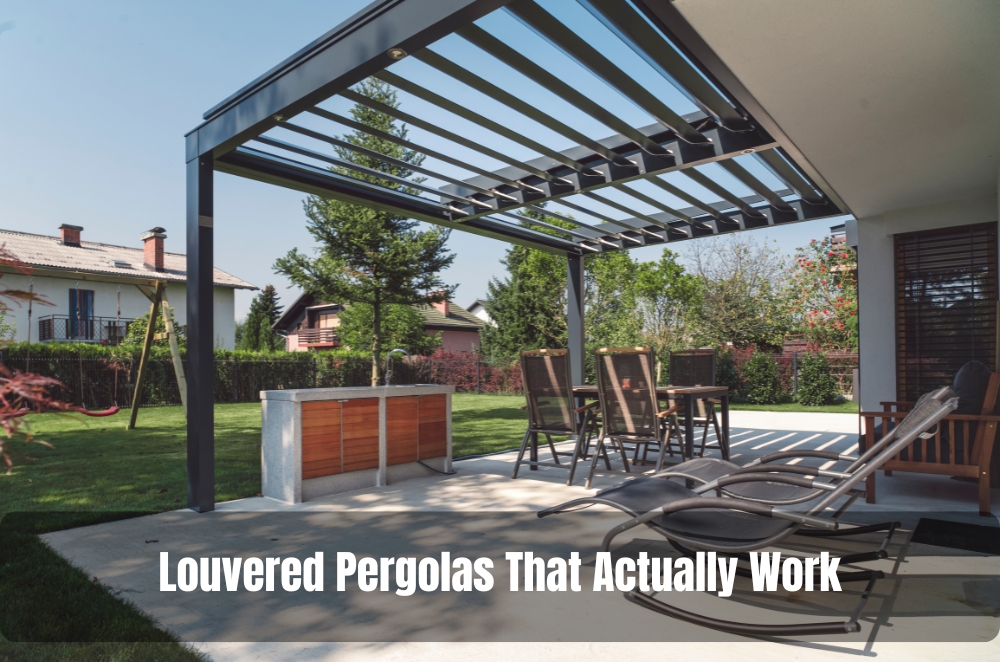
Australians spend more time outdoors than we admit, drifting between sun, shade and whatever the afternoon throws at us. But weather can turn a usable deck into a dead zone without warning, and that’s where adjustable shade truly earns its keep. Over the years, we’ve seen how small choices—blade angle, finish, drainage—change the whole feel of a space. When you want flexibility instead of fixed shade, custom louvered pergolas give you control over light, breeze and privacy without boxing in the view. They slip neatly over timber decks, sit tight against brickwork and make sense in tight courtyards where every centimetre counts. Add lighting and sensors, and the structure quietly adapts to every season.
How do louvered pergolas add liveability?
They extend the hours you can genuinely enjoy an outdoor area, offering adjustable shade and ventilation that match shifting daylight. You get comfort without losing the openness that makes a backyard feel like a true extension of home.
Most homeowners underestimate how much comfort comes from micro-control—angling blades to pull winter sun under an eave, flattening them to cut summer glare, or cracking them open for crossflow. Once lighting and subtle heating join the mix, these spaces hold morning coffee, late-arvo chats and post-dinner wind-downs without feeling staged. And when rain threatens, sensors can shut things down before a downpour sneaks in. The whole point is usability, not fuss.
As you fine-tune a space, small tweaks make a surprisingly big difference, shaping how people move, sit and gather. That’s where our running list of practical louvered pergola ideas comes in handy, especially for homes trying to maximise compact yards.
- Choose blade colours that reduce glare
- Align blades to prevailing breezes
- Use dimmable lighting for evening comfort
With those details sorted, a pergola stops being an add-on and starts feeling like a natural part of the home’s rhythm.
What matters most in Australian conditions?
The short answer: durability and thoughtful detailing. Australia’s mix of sun, salt and sudden downpours punishes half-baked builds, so long-lasting materials matter—powder-coated aluminium, marine-grade fasteners and clean drainage paths that don’t dump water where it shouldn’t go.
Orientation is the second big piece. North-facing spots benefit from winter sun, while west-facing areas demand firmer summer defence. Getting this right shapes comfort throughout the year. Privacy is another silent factor; angled blades can screen neighbouring windows without cramping the space. And if you’re working with homes that lean coastal, heritage or minimalist, blending colour tones and profiles with existing architecture is always the smarter move.
Sound design also hides the bits no one wants to see—wiring, fixings, and gutter lines that might otherwise distract from the clean ceiling effect a good louvered system provides. When everything’s tucked away, the structure feels intentional, not improvised.
- Specify marine-grade fasteners near coasts
- Conceal wiring for a cleaner ceiling line
- Set the proper fall for quieter, faster drainage
These decisions dial in longevity, and in a climate like ours, longevity is half the battle.
Where does a wall-mounted option shine?
When a façade or eave is strong enough to take the load, wall-mounted systems offer coverage without adding chunky posts that disrupt foot traffic or clutter narrow zones. They’re especially useful alongside returns, over laundry doors or in those slim spaces where depth is tight but shade is still essential.
A fixed wall plate stiffens the structure, allowing broader clear spans and freeing up sightlines from kitchen to garden. Retrofit work is usually straightforward if the substrate is sound—brick, block, or properly framed timber. Add sliding screens, and you instantly change how the space handles wind, glare and privacy. Instead of being “just a cover,” the pergola behaves like a flexible outdoor room that adapts to shifting conditions.
And in blocks where outdoor areas feel pinched, the ability to mount directly to a wall without adding posts can buy back valuable metres. That small architectural shift often changes how families actually use the space, turning cramped walk-throughs into functional gathering zones.
conclusion
Louvered pergolas don’t need bells and whistles; they simply need to work with the weather rather than against it. Start with orientation, follow through with durable finishes, and wire in those understated touches—sensors, dimmers, discreet heat—because comfort compounds when done quietly. In homes short on space, wall-mounted designs offer practical coverage without shutting everything in, and inspiration is easy to find through solid Aussie examples like wall-mounted pergola ideas that show how simple tweaks lift usability. When the details land right, weekends drift outside naturally, and the forecast becomes background noise instead of a barrier.