Dear DeSci Friend ⚘
Some time ago, we posted a tweet asking the Twitter community: Who are the women in DeSci we should follow? One of the first responses was, "Unfortunately, I don't know any."
˙◠˙
At DeSciWorld, we are committed to creating more ⋆visibility and opportunities for women in the space. That’s why we launched Women in DeSci, a weekly series of articles highlighting one woman at a time. Each story aims to amplify voices, spark inspiration, and help build a more inclusive future for science.
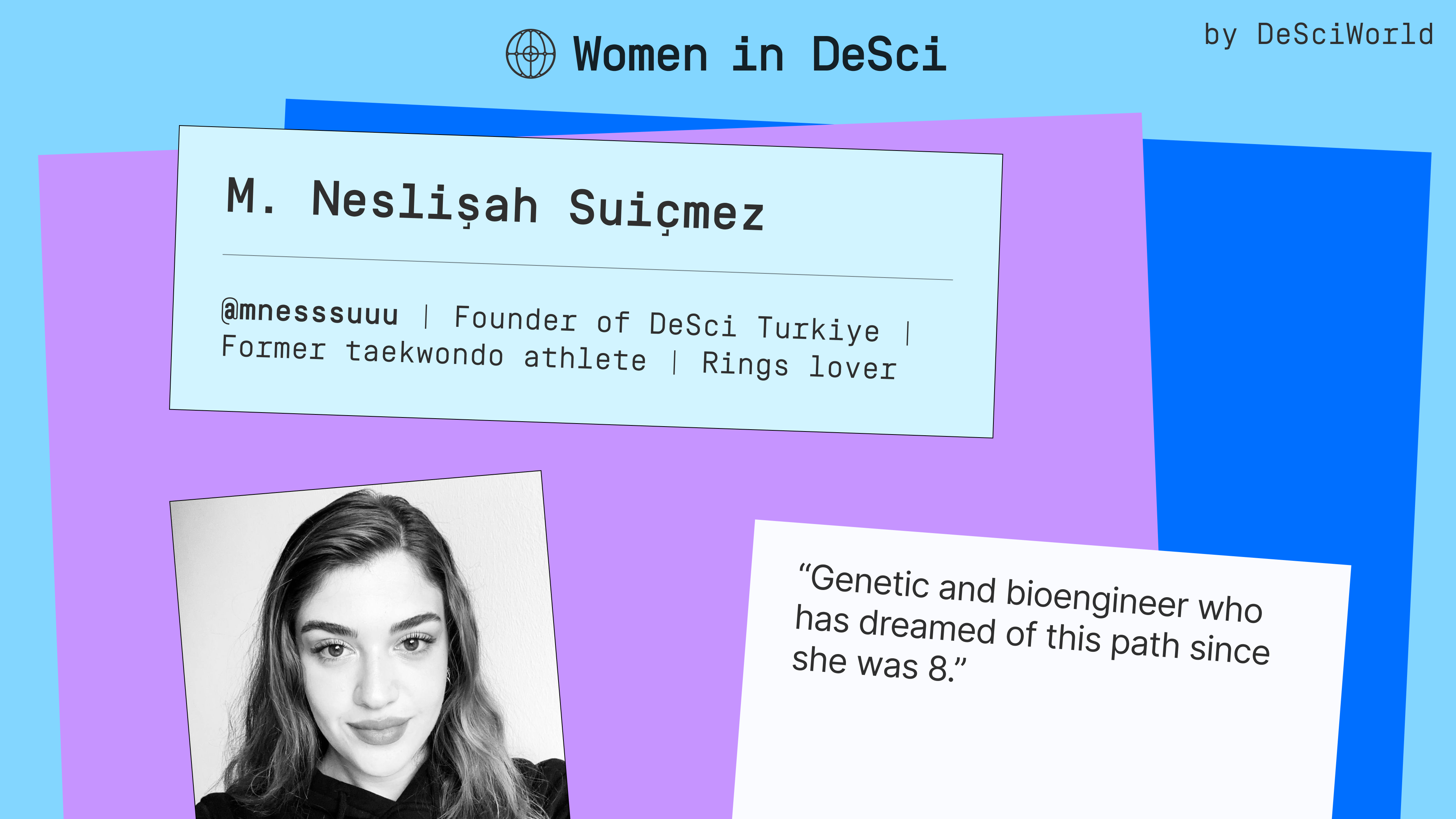
This week, we interviewed ☁︎ Neslişah Suiçmez ☁︎, who decided she wanted to become a genetic and bioengineer at just 8 years old. She is passionate about supplement science, longevity, self-care, and has a serious love for rings.
What's your academic background — what did you study and where?
I’ve been into computers since childhood, but my lifelong dream was to become a genetic engineer. I studied Genetic and Bioengineering in Türkiye — the country where I was born and raised. Later, I moved to Germany to pursue a Master’s degree in Bioinformatics at Saarland University.
Alongside my academic path, I’ve also spent the past 3 years working in the Web3 space, primarily in DeFi and DAO ecosystems. I’ve been actively involved in global events and hackathons, contributing to communities and learning how decentralized systems can reshape real-world industries.
My main interest lies in personalized diagnostics, precision therapies, and drug design — areas where I believe bioinformatics and DeSci can make a real impact.
What first inspired you to get involved in DeSci?
I’ve always valued being multidisciplinary. I’ve been building in the Web3 space for over five years, but genetic engineering has always been my dream profession. While looking for a way to bring together the two fields I love — science and decentralization — I discovered DeSci.
Coming from a traditional academic background, I’m very familiar with the challenges students and researchers face. That’s why open access and inclusivity matter deeply to me. I also love communicating science, so making it more approachable and reachable for everyone has become part of my mission.
Is there a moment you felt especially proud to be part of the DeSci movement?
I’ve realized that many people in the Web3 space still don’t fully understand what DeSci really stands for. That’s why I feel responsible for explaining it in depth — especially because I come from both worlds: traditional science and Web3.
When I meet skeptics, I often say, “Come hear it from someone who’s lived both sides.” I try to show not only the challenges scientists face from within academia, but also how deeply I love my field.
One of my proudest moments is when people come up to me after a talk and say, “Yes, we really needed to hear this from you.” That means the world to me.
What kind of partnerships (with governments, universities, labs) do you think DeSci needs to grow?
First and foremost, academia needs more exposure to Web3 — along with clear regulatory frameworks that allow innovation without fear. Traditional science often operates under strict rules that can resist change, so fostering openness to experimentation is essential.
That’s why integrating Web3 into existing Web2 research structures — universities, research labs, and institutions — is key. We need more individuals who have experience in both domains to act as trusted bridges, building with both credibility and technical understanding.
What kind of partnerships (with governments, universities, labs) do you think DeSci needs to grow?
First and foremost, academia needs more exposure to Web3 — along with clear regulatory frameworks that allow innovation without fear. Traditional science often operates under strict rules that can resist change, so fostering openness to experimentation is essential.
That’s why integrating Web3 into existing Web2 research structures — universities, research labs, and institutions — is key. We need more individuals who have experience in both domains to act as trusted bridges, building with both credibility and technical understanding.
Where do you see DeSci making the most impact over the next 5 years?
“I believe the strongest impact will come from the convergence of DeSci with micro-laboratories and AI agent economies.
The rise of decentralized, modular labs — powered by open protocols and autonomous AI agents — can democratize scientific experimentation like never before. I see a future where scientific research is not just more accessible, but also faster, smarter, and globally coordinated, even outside of traditional institutions.
This intersection excites me deeply because it empowers individuals to build, test, and publish — all from a decentralized and intelligent framework.”
Which DeSci concept makes you geek out the most?
I call it Science 3.0 — the evolution of science through AI, DeSci, and biotechnology. This multidisciplinary transformation is what excites me the most. It’s not just a new method; it’s a new mindset for how science can be done in a more open, intelligent, and decentralized way.
If you could collaborate with any scientist, living or dead, who would it be? And why?
I’d love to approach this from a different angle. I’d choose Imhotep — the ancient polymath often considered the first recorded physician. As someone who values multidisciplinarity deeply, I find his life and ideas fascinating. Despite the limitations of his time, he managed to blend architecture, medicine, and philosophy. I’d be curious to learn how he approached complex problems and what his ideals were in a world without modern tools — yet full of wisdom.
More interviews are on the way.
If this story inspired you, ‧₊˚ ☁️⋅♡🪐༘⋆share it with someone who might enjoy it too.
Every share helps us grow a more open 👩🏻🔬⚗️🧪🥼 and inclusive science community.
Warmly,
The DeSciWorld team •ᴗ•