

For decades, flying cars have been a staple of science fiction, symbolizing the future of transportation. Today, thanks to radical advancements in electric propulsion, autonomous systems, and lightweight materials, that future is closer than ever. The SkyRide Revolution is here—transforming urban mobility and redefining how we travel.
This article explores the why, when, how much, how to, project costing, where, and design behind flying cars, along with a look at the key players making it happen.
Why Flying Cars? The Need for SkyRide Technology
1. Solving Urban Congestion
With over 60% of the world’s population expected to live in cities by 2030, traffic congestion is a growing crisis. Flying cars (or eVTOLs—electric Vertical Take-Off and Landing vehicles) could reduce road dependence by taking transportation into the third dimension—the sky.
2. Environmental Benefits
Most flying car prototypes are fully electric, producing zero emissions. Compared to traditional gas-powered vehicles and helicopters (which are noisy and polluting), eVTOLs offer a greener, quieter alternative.
3. Faster Commutes
A 2-hour road trip could become a 20-minute flight. Companies like Joby Aviation and Archer Aviation are designing eVTOLs that can travel 150-200 mph, making regional travel exponentially faster.
4. Emergency & Logistics Applications
Flying cars aren’t just for passengers—they can revolutionize:
- Medical transport (faster organ deliveries, air ambulances)
- Disaster response (quick deployment in floods or earthquakes)
- Last-mile delivery (Amazon and UPS are already testing drone deliveries)
When Will Flying Cars Be Available?
2024-2025: Test Flights & Early Prototypes
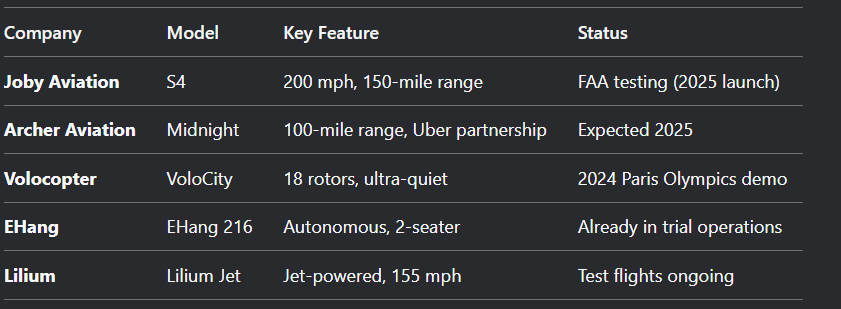
- Joby Aviation has completed FAA certification testing and aims for commercial rollout by 2025.
- Volocopter (Germany) plans to launch air taxi services during the 2024 Paris Olympics.
- EHang (China) already operates autonomous passenger drones in limited trials.
2026-2030: Mass Commercialization
By the end of the decade, experts predict:
- Uber Air and Hyundai’s Supernal will launch urban air mobility networks.
- Major cities (Dubai, Los Angeles, Singapore) will have vertiports (skyports for flying taxis).
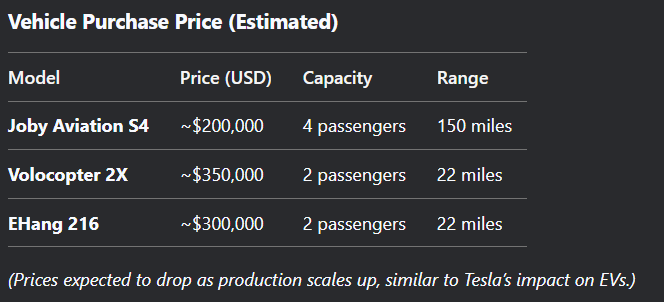
- Prices will drop as production scales up (similar to early electric cars).
How Do Flying Cars Work? The Tech Behind eVTOLs
1. Electric Propulsion
Unlike helicopters (which use combustion engines), eVTOLs rely on multiple electric motors and rotors for lift and thrust. This makes them:
- Quieter (no loud engine noise)
- More efficient (lower energy costs)
- Easier to maintain (fewer moving parts)
2. Autonomous & AI-Powered Navigation
Most flying cars will use AI-driven autopilot to avoid collisions, adjust flight paths, and ensure safety. Companies like Wisk Aero (backed by Boeing) are developing fully autonomous models.
3. Lightweight Materials
Advanced carbon fiber composites and aluminum alloys keep weight low while maintaining strength—key for energy efficiency.
4. Battery Technology
Current lithium-ion batteries are improving, but solid-state batteries (expected by 2030) could double flight ranges. Most eVTOLs today have a 100-200 mile range per charge.
How Much Will Flying Cars Cost?
Operating Costs (Air Taxi Services)
- Initial rides: 100−100−300 per trip (comparable to helicopter charters)
- Future (2030+): 50−50−100 per ride (with autonomous fleets)
Infrastructure Costs (Vertiports, Charging, Air Traffic Control)
- A single vertiport: 5𝑀−5M−10M
- City-wide network (e.g., Los Angeles): $500M+
How to Own or Ride a Flying Car
1. Buying a Personal eVTOL
- Licensing: Pilots may need a special eVTOL certification (easier than a helicopter license).
- Charging: Home charging stations or dedicated vertiports.
- Maintenance: Subscription-based servicing (similar to Tesla’s model).
2. Using Air Taxi Services
- App-based booking (Uber Air, Archer Midnight, Volocopter).
- Vertiport hubs at airports, rooftops, and major transit centers.
3. Regulatory Approval
- FAA (USA), EASA (Europe), and CAAC (China) are developing safety and air traffic rules.
- First commercial approvals expected by 2025-2026.
Where Will Flying Cars Operate First?
1. Dubai (UAE)
- Pioneering air taxis with EHang and Volocopter trials.
- Goal: 30% of passenger transport via autonomous air taxis by 2030.
2. Los Angeles (USA)
- Uber Air and Joby Aviation are planning LA-to-San Diego routes.
3. Singapore
- Strict traffic laws make it ideal for testing.
- Hyundai’s Supernal is investing heavily here.
4. European Cities (Paris, Munich, London)
- Volocopter and Lilium Jet are targeting 2025-2027 launches.
Who Is Designing Flying Cars? Key Companies Leading the Revolution
Conclusion: The Future of Transportation Is in the Sky
The SkyRide Revolution is no longer a fantasy—it’s an imminent reality. With breakthroughs in battery tech, AI autonomy, and regulatory support, flying cars will soon become a viable mode of transport.
Key Takeaways:
✔ 2025-2030 will see the first commercial air taxis.✔ Prices will start high ($200K+ per vehicle) but drop with mass adoption.✔ Autonomous eVTOLs will dominate, reducing the need for pilot licenses.✔ Cities like Dubai, LA, and Singapore will lead the rollout.
The dream of flying cars is finally taking off—are you ready for the SkyRide Revolution? 🚀