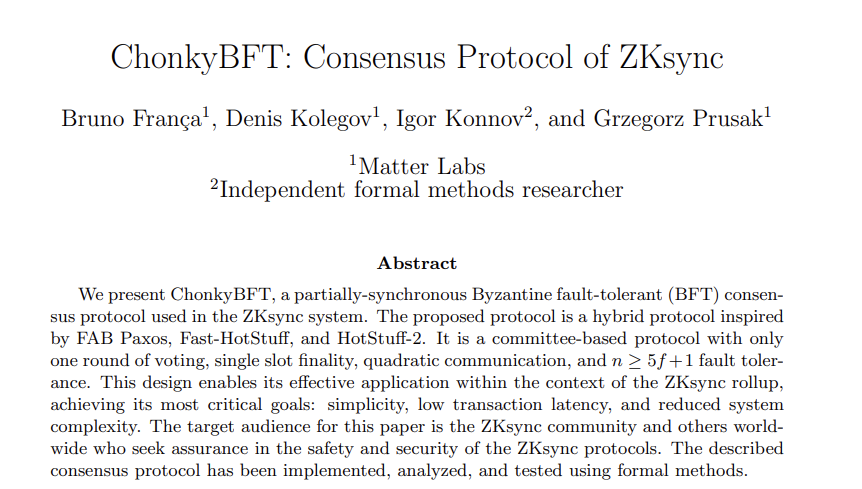
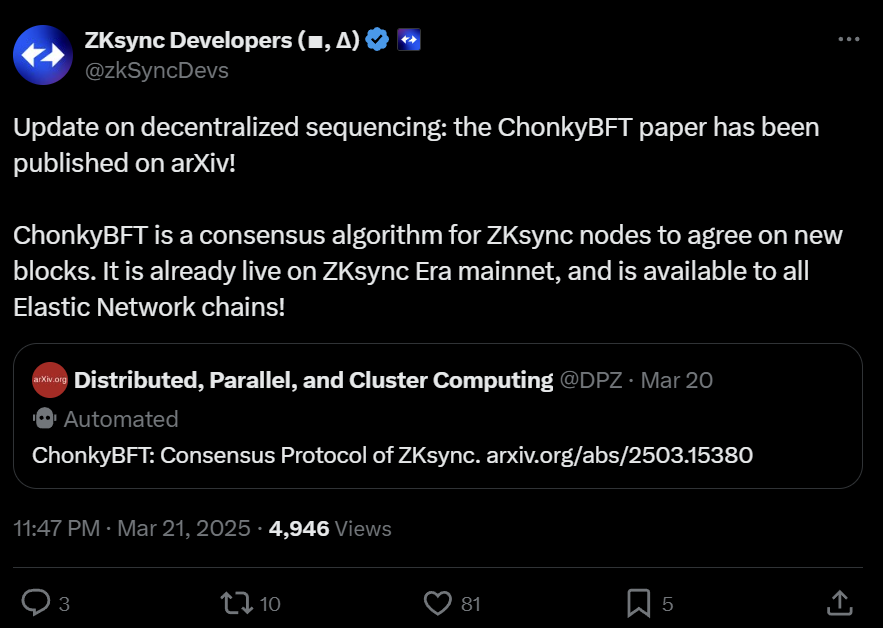
MatterLabs has just announced an updated research paper on ChonkyBFT representing a major technical leap in how blockchains process transactions, especially for ZKsync.
This consensus mechanism is engineered for high throughput, low latency, and strong finality while aligning with the network’s mission to support decentralized sequencing.
In this article, we’ll unpack what ChonkyBFT is, how it advances decentralization on ZKsync, and the broader implications of this upgrade.
What is the ChonkyBFT?
ChonkyBFT is a new consensus protocol introduced by ZKsync’s core team to power its decentralized sequencer.
BFT stands for Byzantine Fault Tolerance, a property that allows distributed systems to reach consensus even when some participants are unreliable or malicious.
ChonkyBFT builds on this idea but is specifically optimized for the performance needs of ZKsync's rollup environment.
Unlike traditional BFT protocols that can become inefficient or fragile under scale, ChonkyBFT is designed to be highly performant in Layer 2 settings. It introduces a two-round voting system with leader rotation, ensuring that blocks are confirmed quickly and without central coordination.
Each round consists of a proposal followed by a voting phase, and once enough votes are collected, the block is finalized. This minimizes latency while ensuring safety and liveness.
One of the key innovations in ChonkyBFT is its separation of roles. Validators are split into proposers and voters, allowing the protocol to scale horizontally.
This structure prevents bottlenecks by distributing responsibilities and limits the risk of sequencer centralization.
Additionally, the protocol is designed with cryptoeconomic penalties to discourage bad behavior, ensuring the system stays honest over time.
ChonkyBFT is being built from the ground up to integrate with ZKsync's upcoming zkEVM stack and future-proof its decentralized roadmap.
Its modularity means it can evolve, with upgrades that maintain compatibility with ZKsync’s zero-knowledge-proof systems. Altogether, it offers a robust, fast, and fault-tolerant foundation to power ZKsync's growing user and developer base.
How ChonkyBFT Enables Decentralized Sequencing
To understand ChonkyBFT’s importance, we first need to grasp what decentralized sequencing means. In a rollup like ZKsync, the sequencer is the entity that orders transactions before they are sent to Ethereum.
In current systems, this sequencer is often centralized, introducing potential concerns over censorship, front-running, and liveness. Decentralized sequencing removes this single point of failure by distributing sequencing duties across a network of participants.
ChonkyBFT is the protocol that enables this distribution. It replaces the single centralized sequencer with a committee of validators who use Byzantine Fault Tolerant consensus to decide on transaction order.
These validators are randomly selected and rotated regularly to prevent any group from monopolizing the role. By involving multiple participants in the sequencing process, ZKsync ensures that no single entity can censor or reorder transactions for their benefit.
Another key aspect is liveness and responsiveness. Many decentralized consensus systems suffer from delays or stalling under poor network conditions. ChonkyBFT tackles this by using a two-step voting process with fast timeouts and clear fallback logic.
If one proposer fails or delays, the protocol moves on quickly to the next, keeping block production moving smoothly. This is critical for a network like ZKsync that needs to support real-time applications such as payments, trading, and gaming.
ChonkyBFT also prioritizes crypto-economic security. Validators must stake assets and risk slashing if they behave dishonestly. This aligns incentives and provides strong guarantees against collusion or downtime.
Importantly, the protocol is permissionless, meaning anyone who meets the staking criteria can participate. This opens the door to broader community involvement in securing and operating the network.
By deploying ChonkyBFT, ZKsync takes a major step toward fulfilling its promise of neutrality and censorship resistance.
Sequencing becomes a shared responsibility, governed by code and incentives rather than trust. This advances both the technical integrity and the decentralization ethos of the network.
How This Impacts ZKsync’s Infrastructure
The integration of ChonkyBFT into ZKsync’s architecture brings significant benefits to the ecosystem.
First, it signals the beginning of ZKsync’s transition from a centralized rollup to a truly decentralized Layer 2 network. This aligns with its long-term vision to support permissionless applications and guarantee fairness in transaction processing.
With decentralized sequencing, developers and users can trust that the transaction ordering process is transparent and not subject to hidden manipulation. This is crucial for sectors like DeFi, where ordering affects slippage, liquidation, and arbitrage.
By removing a central coordinator, ZKsync reduces the risk of MEV (Miner Extractable Value) exploitation, making the network more predictable and equitable.
Performance is another key gain. ChonkyBFT is not just decentralization for its own sake. It is engineered to scale with demand while maintaining sub-second finality. This means faster transactions, better user experience, and higher throughput during peak periods.
Unlike many BFT protocols that degrade under stress, ChonkyBFT is optimized for real-world load and dynamic validator sets.
ZKsync also benefits from flexibility. ChonkyBFT’s modular design allows for further upgrades and experimentation.
For example, the protocol can incorporate zk-SNARK-friendly components in future versions, maintaining compatibility with ZKsync’s proof system.
It also supports a wide range of validator strategies, from solo staking to delegation, giving more users a pathway to participate in network governance and operation.
Perhaps most importantly, ChonkyBFT reinforces ZKsync’s commitment to community governance.
Decentralized sequencing enables mechanisms like proposer elections, public slashing appeals, and transparent fee markets. This opens the door for more democratic input into how the network operates.
In the long term, this could evolve into a full on-chain governance framework where protocol upgrades and economic rules are decided by token holders or community representatives.
The implementation of ChonkyBFT shows that decentralization does not need to come at the cost of usability or speed.
ZKsync is setting a precedent for how Layer 2 protocols can combine robust technical design with transparent governance and decentralization.
It is a move that positions the network as not just a scalability solution but as a credible alternative for building open financial infrastructure.
Conclusion
ChonkyBFT represents a major advancement for ZKsync by delivering fast, reliable, and decentralized sequencing.
It transforms the role of the sequencer from a central actor into a distributed committee governed by transparent rules and incentives.
This upgrade not only improves the technical performance of the network but also strengthens its decentralization, trust, and future scalability. ZKsync’s ecosystem is now better prepared to support the next generation of applications.