In many online communities and collaborative environments, it can be a challenge to aggregate multiple users’ goals, questions, and requests into a single coherent direction. We often talk about “community intent” or “group intent,” but how do we actually identify and manage that intent? That’s where the concept of an agent as a group intent parser comes into play.
From Individual Intents to Community Intents
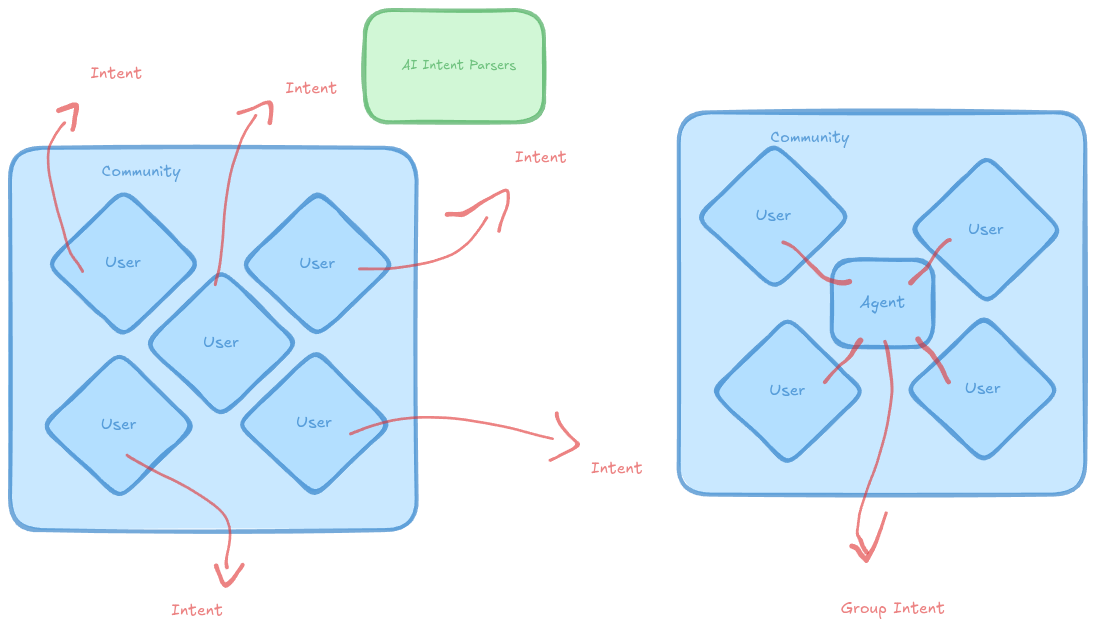
In the left-hand portion of the diagram, you see several users—each shown in a diamond shape—within a large community box. These users generate various intents (shown by red arrows) and send them outward. An external system, labeled “AI Intent Parsers,” tries to interpret or “parse” these individual requests.
- Individual focus: Each user’s intent is recognized in isolation, often without considering the broader community context.
- Distributed interpretation: Every user “speaks” directly to the AI, and the AI attempts to interpret each request separately.
- Coordination challenge: While this setup works for single-user queries, it can become messy when multiple users need to converge on shared goals or make group decisions.
The Emergence of a Group Intent
Now look at the right-hand side of the diagram: you still see the same community of users in the blue box, but at the center is a single agent. Instead of each user sending individual intents separately to an external AI, these users channel their goals and questions into one place—the agent.
- Central “agent” node: This agent sits at the intersection of all user intents.
- Collective intelligence: The agent doesn’t just parse individual user requests; it synthesizes them, merges them, and resolves conflicts to produce a group intent.
- Clearer decisions: Because the agent has the complete picture, it can surface not only each user’s needs but also the broader community trends.
Why an Agent?
You might wonder, why introduce a dedicated agent when AI Parsers on the left can already interpret user messages? In short, because an agent can:
- Contextualize user queries: The agent is aware of the ongoing conversations, the community’s history, and collective goals.
- Handle conflicts and redundancies: When two or more users have conflicting requests or redundant questions, the agent can detect overlaps, merge related requests, or open a dialogue around conflicts.
- Provide accountability: A single agent can keep an “audit trail” of which user intent led to which decisions, making it easier to understand how outcomes were reached.
- Generate group-centric insights: The agent doesn’t just parse requests; it can also propose next steps for the entire group, suggest relevant content, and help coordinate community actions.
Group Intent vs. Individual Intent
The difference between handling individual intent parsing and group intent parsing is subtle but important:
- Individual intent: “I want the system to answer my question.”
- Group intent: “We, as a community, want to accomplish X.”
When you only have individual intent parsing (left side), the AI might handle each user’s request but never unify them. By contrast, an agent that focuses on group intent (right side) looks for ways to weave those requests into shared outcomes. It’s the difference between a set of disconnected one-on-one conversations and a collective discussion with a shared objective.
2. What Are Collectives?
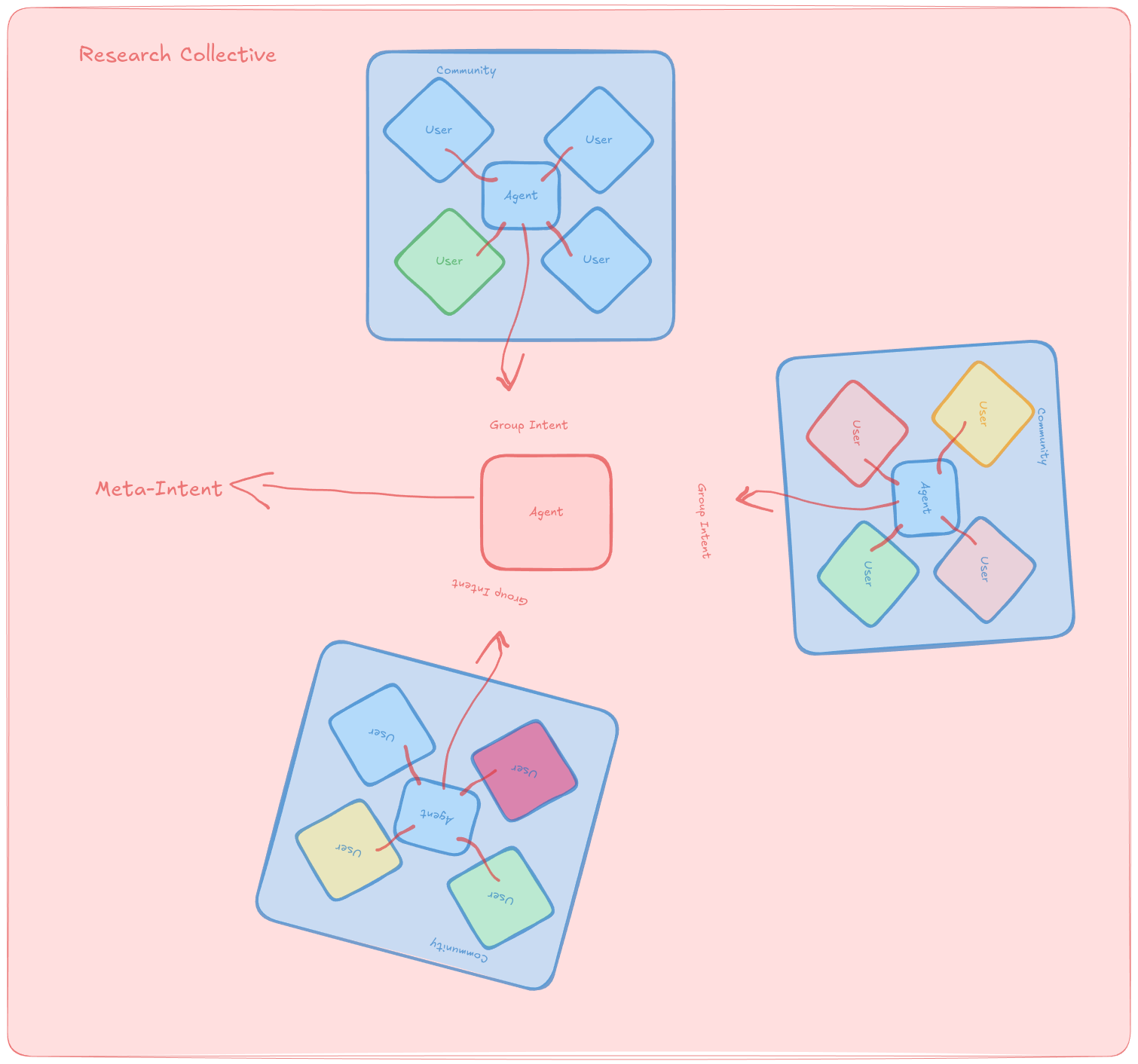
In this context, a collective is a group of users (and possibly sub-agents) working toward a shared objective. Each community has an internal agent that parses, synthesizes, and organizes user input
- Users: Individuals who have their own intentions, knowledge, or tasks.
- Agent: A local “orchestrator” that merges user inputs within each community.
Collectives can coordinate among themselves to refine or align goals, ultimately generating an overarching Group Intent—the consensus or combined mission. This Group Intent is then passed to a higher-level agent (in red in the diagram) which synthesizes everything into a Meta-Intent.
3. The Flow of Group Intent
- Individual Users Share Their PerspectivesWithin each community, users generate ideas, questions, or tasks based on their unique vantage points.Example: User A might want a new feature in a product, while User B needs more documentation.
- Local Agent Parses User InputActing as a facilitator, the local agent collects user requests and resolves possible conflicts.The agent might employ intent parsing—identifying the core aims behind each user’s statement.
- Community AlignmentThe local agent helps the community converge on a shared stance or local consensus.At this point, the community effectively forms its own “group intent,” reflecting the internal priorities.
- Group Intent Flows UpwardThe group-level statements or decisions are passed on to a central (red) agent.This higher-level agent takes inputs from multiple communities or collectives, each with its own agent.
- Meta-Intent CreationThe central agent merges multiple group intents into a single meta-intent.This meta-intent is essentially the global consensus or strategic directive that spans all communities.
4. Why Use Collectives?
Parallel Ideation
Multiple communities can brainstorm or tackle problems concurrently. Each community agent synthesizes the best ideas from its members.
Conflict Resolution at Scale
When user needs or goals diverge, local communities can deliberate and refine their stance before sending it upward. This distributed approach can be more efficient than having one massive discussion with everyone at once.
Contextual Specialization
Each community might focus on a specific domain (e.g., marketing, engineering, research). Its local agent is optimized for that context, so the ultimate meta-intent benefits from specialized insights.
Transparent Delegation
A hierarchical arrangement ensures that each local agent’s reasoning, decisions, or summaries are traceable. Users can see how their local input shapes the broader group intent.
6. Agent Roles Within Collectives
- Local Agent (Community Level)Function: Gathers and organizes user intentions, negotiates conflicting ideas, and produces a cohesive output (the group intent).Tools: May use natural language understanding, knowledge graphs, or feedback loops to continuously refine user inputs.
- Central or Meta-Level Agent (Global Level)Function: Consumes group intents from various communities and merges them into a unified meta-intent.Tools: Might use advanced summarization algorithms, advanced logic for consensus building, or even AI-based negotiation tools if communities disagree.
7. Practical Applications
- Distributed Research ProjectsScenario: Different labs or research teams, each tackling a subsection of a grand challenge (e.g., climate modeling).How It Works: Each collective’s local agent refines the specialized data. The meta-agent then integrates results into an overarching hypothesis or policy recommendation.
- Open-Source Software CommunitiesScenario: Front-end developers, back-end developers, and documentation teams each have a dedicated community agent.How It Works: Local agents surface feature requests or bug reports. The global agent merges them into a coherent roadmap.
- Enterprise WorkflowsScenario: Separate departments (HR, marketing, finance) need to coordinate for strategic planning.How It Works: Each department’s agent compiles their priorities. A central, meta-level agent determines the overall direction—budgets, timelines, resource allocation, etc.
3. Intent Parsing Meets Tokenized Knowledge
3.1 From Quick Answers to Persistent “Cards”
Conventional AI agents perform stateless Q&A: a user query arrives, the system responds, and the conversation context vanishes. The GreenPaper’s Cards and Decks paradigm—rooted in the Magic: The Gathering metaphor—transforms these fleeting exchanges into persistent knowledge artifacts:
- Cards: Each concept, idea, or insight gleaned from user interactions is minted as a “Card,” holding both machine-readable (structured data, embeddings) and human-intuitive (vibes, flavor text) components.
- Decks: The agent (or group of agents) assembles these cards into “Decks,” which represent coherent, curated responses or proposals over time.
When an intent parsing framework (e.g., local user requests flow into an agent’s memory, vector stores, and logic layers) decides how best to respond, it can now instantiate new Cards or augment existing Cards—effectively tokenizing the outcome of the parse. These Cards are then shared or traded within the knowledge ecosystem.
4. PoK and the Bot.Fun Multi-Agent Flow
4.2 Local Intent, Global Impact
Imagine each community or collective from the Bot.Fun diagrams: a cluster of users around a local agent. Instead of ephemeral chat logs, the agent’s “Raw Decks” become the raw Cards minted with on-chain PoK attestations. By anchoring these Cards in a ledger, we ensure verifiability and traceability:
- Parsing a User QueryThe local agent identifies user intent, referencing memory and vector stores.It forms a “Raw Deck” of potential answers or sub-intents.
- PoK AttestationWhen a final response is chosen, it becomes a minted Card, validated and anchored by Proof of Knowledge.The card’s details—embeddings, vibes, explicit data—are stored on-chain or in an IPFS-like environment.
- Distribution & CurationThese newly minted Cards can be shared with the rest of the community (or even other collectives), forming a persistent record of knowledge growth.
2.2 Collectives and Group Intent
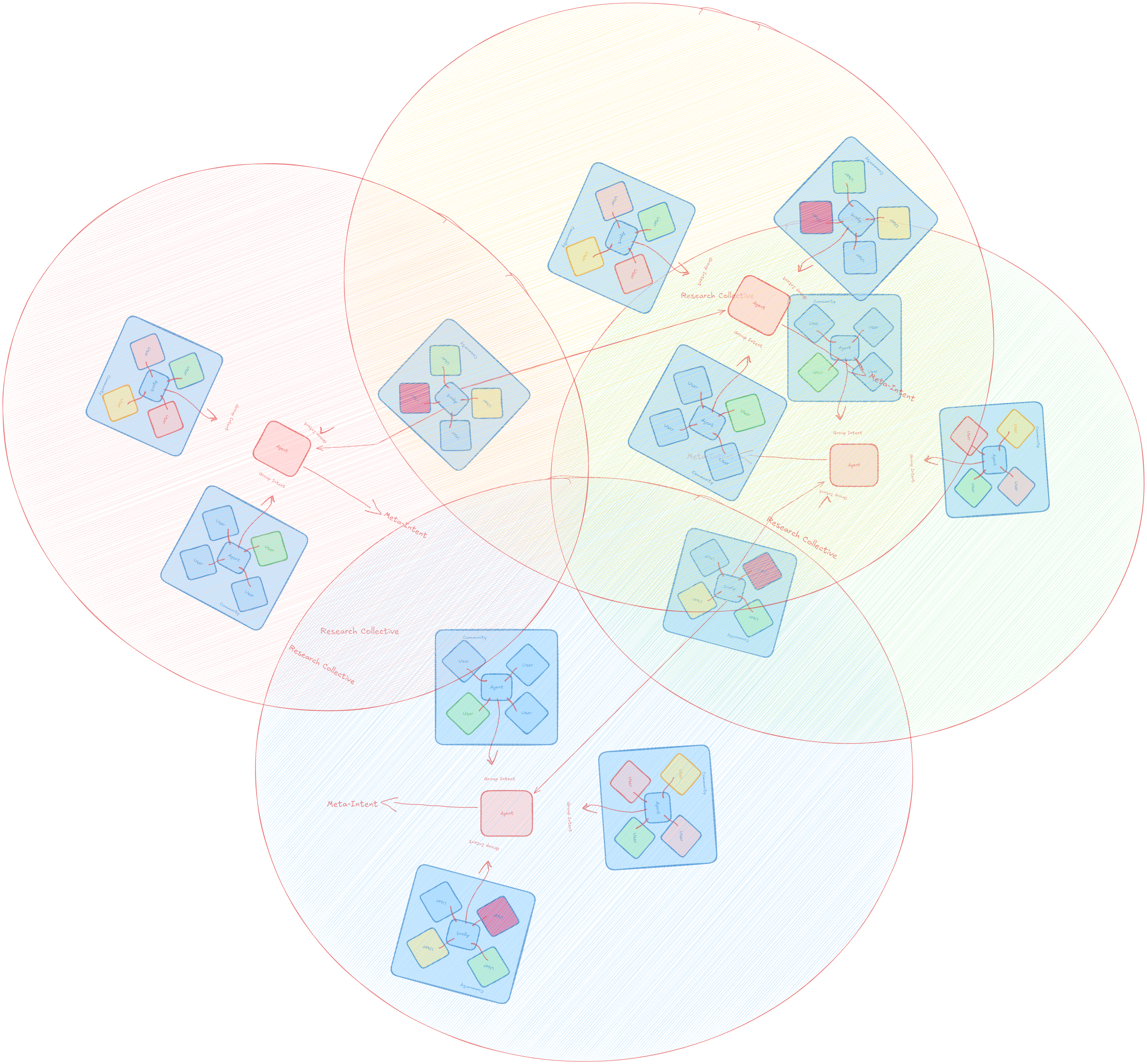
As laid out in the Bot.Fun “collective” diagrams, multiple local agents coordinate, each generating new Cards from user dialogues. A “central agent” merges these local outputs into a meta-intent—in the GreenPaper’s language, that meta-intent is effectively a next-level Deck, representing the combined knowledge from multiple domains.
3. RAG-Driven Knowledge “Decks”
3.1 Dynamic Deck Shuffling in Practice
The GreenPaper’s RAG (Retrieval-Augmented Generation) approach resonates with the Bot.Fun architecture’s layered logic:
- RetrieveThe agent scours the knowledge graph, pulling up relevant Cards from vector stores (where embeddings live).These Cards might come from the local community or from external collectives with relevant “flavor text” or domain expertise.
- AssembleThe agent merges the retrieved Cards into a coherent “Deck” that answers the user’s real-time question.Each Card carries a “vibe signature,” aiding humans in quickly discerning how the knowledge fits together.
- GenerateThe agent uses the curated Deck to produce a refined narrative or explanation. The final output can re-mint or update Cards if new insights arise.
3.2 Intent Parsing as Deck Curation
In place of a single best guess, the agent can produce a Deck, showing possible angles or “sub-intents” derived from the user’s prompt. These sub-intent Cards—some purely conceptual, others referencing external sources—allow users to explore nuanced, multi-faceted answers.
4. Tokenized Incentives (IBO) and Anchor States
4.1 Turning Knowledge Into a Sustainable Economy
The Initial Bot Offering (IBO) from the GreenPaper outlines a marketplace where every newly minted Card has a potential economic value, based on:
- Usage (how often it’s retrieved).
- Quality (community votes or governance).
- Novelty or “vibe synergy” (the card’s resonance across multiple domains).
Local agents (and their developers or validating token-holders) get rewarded whenever their Cards help solve user queries. This spurs a positive feedback loop: the more valuable the knowledge, the more it’s used, leading to more updates, improvements, and further usage.
4.2 Anchors and Goal Progress
Within the Bot.Fun framework, Anchor States represent foundational truths or objectives. In the tokenized system, these Anchors can map to widely accepted knowledge or key goals validated by the community via PoK. If a new Card conflicts with an Anchor, the system triggers a specialized evaluation flow—i.e., “Is this new knowledge actually more accurate than the old anchor, or is it misguided?”
This ensures the knowledge graph evolves with the times, but not without robust, on-chain checks.
5. Practical Example
- Research CollectiveA local agent fields a query on DeFi protocols. Multiple users supply data (charts, experiences).The agent produces a “Raw Deck,” each Card capturing a different insight. It uses RAG to assemble the final explanation.
- Minting CardsCards from that Raw Deck get minted with on-chain attestation.The group invests tokens to validate correctness (PoK). If the knowledge stands up over time, these Cards become more valuable.
- Aggregation and Meta-IntentAnother agent, focusing on decentralized governance, sees these minted DeFi Cards and merges them with NFTs and DAOs data.A meta-intent emerges for how to integrate these protocols into a bigger ecosystem. The newly formed “Deck” is minted as well.
- Ecosystem GrowthOver time, more users discover these minted Cards, incorporate them into their local decks, or refine them with new data—gaining token rewards for verified improvements.
6. Advantages of a Unified Approach
- Persistent ValueEphemeral Q&A transforms into intangible assets that can be traded, curated, and improved over time.
- Incentive AlignmentPoK and IBO tokenomics encourage accurate, useful, and innovative Cards.Knowledge emerges as a “public good” that is nonetheless privately rewardable.
- Human-Machine SynergyThe Magic-inspired “vibe” is intuitive to human collaborators, while embeddings and structured data remain AI-friendly.
- Scalability via CollectivesInstead of one monolithic knowledge base, multiple communities co-create Cards. The system grows organically, with each local agent focusing on a niche yet feeding into the global meta-intent.
- Robust GovernanceAnchor States and on-chain verifications keep the knowledge graph coherent; DAOs or governance tokens fine-tune parameters and resolve disputes.
7. Looking Forward
As outlined in the GreenPaper, Cards and Decks are only the beginning. Future evolutions might include:
- Dynamic “Card Alchemy”: Combining or splitting Cards automatically when new data surfaces, akin to chain-of-thought expansions.
- Federated Collectives: Multiple meta-agents that coordinate on specialized subgraphs (finance, biology, art), then periodically merge their knowledge.
- Cross-Chain Integrations: Storing Cards or validations on multiple chains, making the system more resilient and interoperable.
All of these expansions remain grounded in the same principle: every piece of newly parsed intent leads to an incrementally growing, tokenized knowledge graph, bridging AI efficiency with human creativity.
Conclusion
By layering the GreenPaper’s tokenized knowledge economy onto an intent parsing architecture, we move from passive Q&A to an evolving, self-reinforcing ecosystem. Agents in each collective parse user intentions, mint verifiable Cards, and share them across the broader network. RAG keeps the content adaptable, PoK ensures trust, and tokenomics reward both creators and curators. The result is a living, growing library of machine-parseable and human-friendly knowledge, continuously refined by collaborative intent—and underpinned by real economic value.