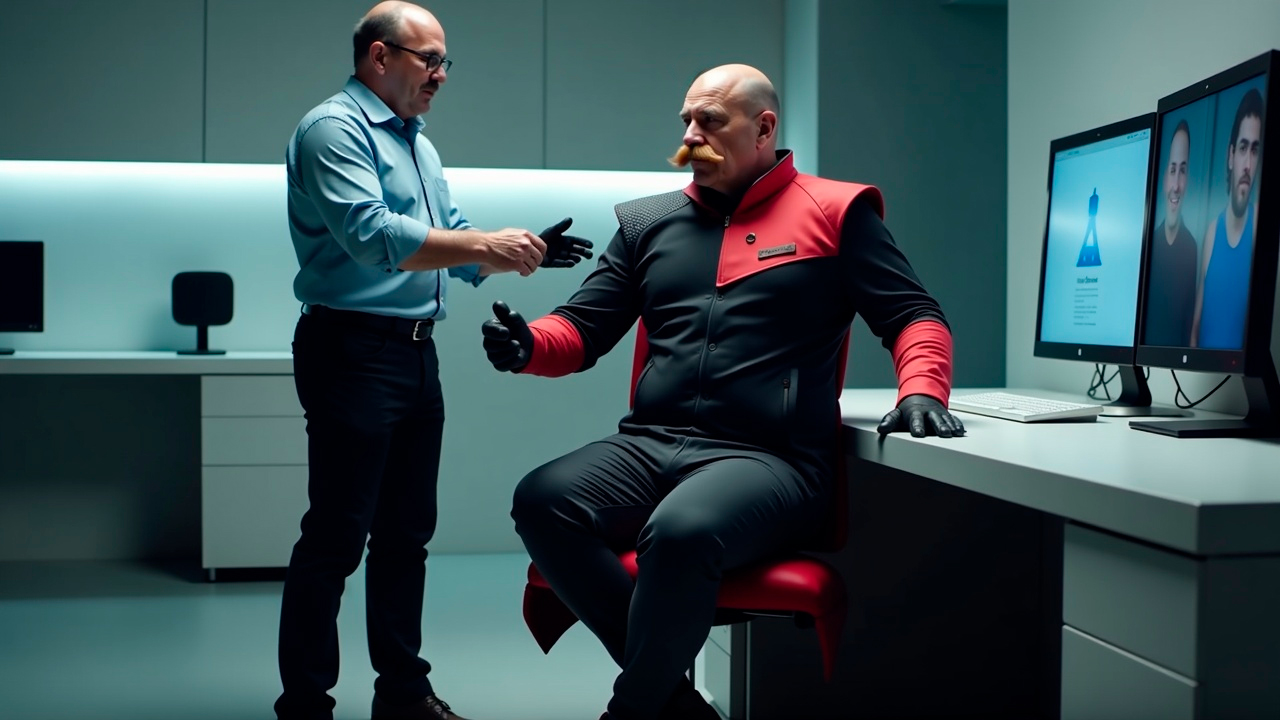
Act 1: The Attack on the Nodes
Doctor Robotnik, obsessed with controlling the world's technology, discovers that Pectra, an upgrade to Ethereum's decentralized system, threatens his centralized empire. He decides to attack the nodes where Pectra rests in order to collapse the Ethereum blockchain. But when he tries to hack a node, he realizes that there is no "center" to destroy: Pectra is part of a decentralized network. Each node is a mirror of the system, and even if he destroys one, thousands more replace it. Discover Pectra's decentralized resilience.
Pectra Qualities Uncovered in Act 1
- 1. Decentralized Resilience: Pectra has no “center” to destroy: it is a decentralized network based on distributed nodes.
- 2. Transparency and Immutability: Pectra smart contracts are transparent and immutable, which prevents fraud.
- 3. Community Self-Evolution: Pectra does not depend on a central leader: its update is managed through community proposals (EIPs).
These qualities demonstrate that Pectra is a resilient, transparent, and self-evolving system, designed to withstand centralized attacks like Robotnik's.
Act 2: The Attempted Fraud in Smart Contracts
Robotnik attempts to corrupt a smart contract to steal funds. He creates malicious code, but Pectra activates its security protocols: the contract is automatically blocked upon detecting anomalies. Robotnik is frustrated to see that the system is transparent and immutable. Users can verify the code in real time, and no fraudulent transactions are executed. He discovers, to his chagrin, the integrity of the contracts.
Pectra's Qualities Discovered in Act 2
- 1. Smart Contract Transparency and Immutability: Pectra ensures that smart contracts are transparent and immutable, preventing fraud.
- 2. Flexibility in Contract Execution: Pectra enables smart contracts to perform complex operations securely.
- 3. Enhanced Security in Validation Operations: Pectra protects validation operations through improvements in deposit and output management.
These qualities demonstrate that Pectra is a transparent, secure and flexible system, designed to resist fraudulent attacks such as Robotnik's.
Act 3: The Token Wars
The villain clones an Ethereum token to create a fake economy. But the network detects the duplication and exposes it publicly. Users, guided by a consensus mechanism, reject the fake token. Robotnik realizes that Pectra on Ethereum does not depend on a leader: it is communal and self-regulating. Every user is part of the system, and manipulation is useless. He discovers the democracy of the blockchain.
Pectra Qualities Uncovered in Act 3
- 1. Democracy and Community Self-Governance: Pectra allows users to manage tokens in a decentralized manner, without relying on a central leader.
- 2. Improved Security in Token Operations: Pectra secures token operations through improvements in deposit and output management.
- 3. Data Layer Optimization: Pectra improves data efficiency at Layer 2 (L2), reducing costs and increasing scalability.
- 4. Flexibility in Token Management: Pectra allows users to manage tokens more flexibly, reducing reliance on intermediaries.
These qualities demonstrate that Pectra is a democratic, secure, and scalable system, designed to withstand centralized attacks such as Robotnik.
Act 4: The Final Assault
Enraged, Robotnik kidnaps a Pectra developer to force him to shut down the system. But the team reveals that Pectra no longer needs developers: it is self-evolving. Users can propose and vote on improvements, and the code updates automatically. While Robotnik shouts threats, the network ignores him and continues to function. He discovers Pectra's eternal independence.
Pectra Qualities Uncovered in Act 4
- 1. Self-Evolution and Technical Flexibility: Pectra is automatically updated through community proposals (EIPs), without the need for a central leader.
- 2. Data Layer (Layer 2) Optimization: Pectra improves Layer 2 (L2) scalability and efficiency through improvements to the data layer.
- 3. Improved Security of Validation Operations: Pectra secures validation operations through improvements to deposit and output management.
- 4. Increased ETH Limit per Validator: Pectra allows validators to manage larger amounts of ETH without the need for multiple validators.
- 5. Improvements to Inter-Layer Communication: Pectra improves the efficiency of communication between the execution layer (EL) and the consensus layer (CL).
These qualities demonstrate that Pectra is a self-evolving, scalable and secure system, designed to withstand centralized attacks such as Robotnik's.
Epilogue: Doctor Robotnik's Escape and the Threat of FUSAKA
Defeated and humiliated, Doctor Robotnik flees the Pectra network, whose resilience, transparency, and self-evolution have outpaced him in every attempt at sabotage. As he escapes in his ship, Robotnik swears revenge: “Pectra is not invincible… Its next update, FUSAKA, will be my chance!”
In the darkness of cyberspace, Robotnik studies rumors about **FUSAKA**, the next major Ethereum update that will follow Pectra. There he discovers proposals such as:
- EOF (Ethereum Object Format): A modular system for smart contracts that will reduce costs and optimize executions, which could be exploited to create more efficient malware.
- Verkle Trees: A data structure that will make Ethereum more scalable and “stateless,” but which requires a complex transition, vulnerable to attacks during its implementation.
- EIP-7594 (PeerDAS) and EIP-7623: Data layer improvements that Robotnik will try to manipulate to create bottlenecks or fake blobs on Layer 2.
As the Ethereum community prepares for FUSAKA, Robotnik plans to use its temporary weaknesses against it. But the developers, now more united after the Pectra resistance, are already designing countermeasures.
The story continues...