UBS, Switzerland’s largest bank, is testing a new way to manage gold investments using ZKsync’s Validium, an Ethereum layer-2 solution.
The bank’s tokenized gold product, UBS Key4 Gold, aims to make buying and selling gold more efficient, secure, and accessible.
This move shows how traditional finance is starting to adopt blockchain technology in practical ways. UBS’s trial could mark an important shift in how financial institutions approach digital assets and blockchain networks.
UBS Moves Gold Investments On-Chain with ZKsync
UBS is running a proof of concept (PoC) for its tokenized gold product, UBS Key4 Gold, on ZKsync Validium.
This product allows people to buy and sell small amounts of gold digitally, offering a new way to invest in one of the world’s oldest assets. Instead of using traditional systems, UBS is now exploring blockchain to improve how gold is traded and managed.
Key4 Gold was originally built on UBS’s private blockchain, designed to connect gold vaults, liquidity providers, and distributors.
But with the shift to ZKsync, UBS is testing whether this technology can solve common issues in finance, like slow transaction times, high costs, and privacy concerns. ZKsync Validium helps with all of these by allowing faster transactions and more control over data.
The proof of concept has been a success so far. UBS has managed to deploy smart contracts on ZKsync’s testnet, showing that blockchain can handle complex financial products.
This is more than just an experiment, as it is a sign that UBS is serious about using blockchain to improve its services.
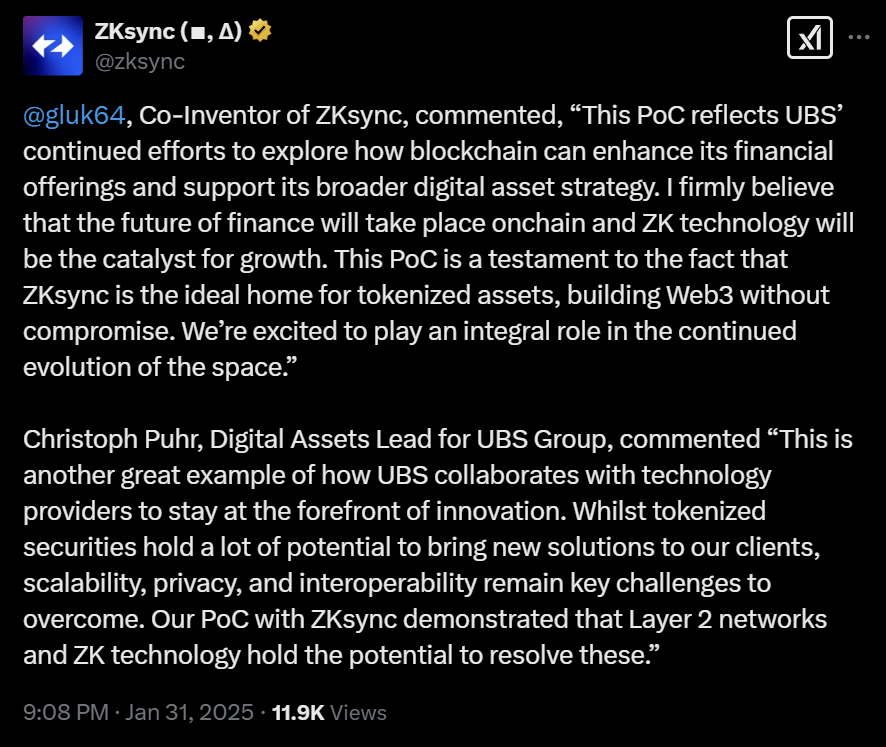
Alex Gluchowski, co-founder of ZKsync, highlighted how this project reflects UBS’s efforts to modernise its offerings. According to him, blockchain technology, especially with zero-knowledge proofs like Validium, could play a key role in the future of finance.
This move by UBS is an early step, but it could open the door for more traditional banks to explore similar blockchain solutions.
A New Chapter for Crypto Adoption
UBS’s move to test tokenized gold on ZKsync isn’t just another experiment, as it is a sign that crypto is becoming more embedded in the financial system.
For years, blockchain was seen mainly as a tool for cryptocurrencies like Bitcoin and Ethereum. But now, it’s being used to manage traditional assets like gold, showing how versatile the technology can be.
What’s important here is that UBS isn’t using Ethereum’s main network. Instead, they’ve chosen a layer-2 solution, ZKsync Validium, which focuses on making transactions faster and more private.
This shift highlights a key development, which is that financial institutions are moving beyond just experimenting with blockchain. They’re now choosing specific technologies that meet their needs.
This makes crypto more than just an alternative, as it is becoming a practical tool for real-world finance, specifically the traditional asset market.
This also shows how crypto adoption is evolving. It’s no longer just about digital coins and tokens. Now, it’s about using blockchain to improve traditional financial products.
UBS’s decision could influence other banks to follow suit, leading to wider use of blockchain technology in areas like trading, asset management, and even everyday banking.
Moreover, this development could change how people view crypto. When a major bank like UBS adopts blockchain for something as traditional as gold investments, it sends a strong message: blockchain isn’t just for tech enthusiasts, as it is for everyone.
This could help bridge the gap between traditional finance and the crypto world, making blockchain a standard part of how we manage and invest money in the future.
UBS: The Financial Giant Behind the Adoption
UBS isn’t just another retail bank, it is the largest in Switzerland and one of the most influential financial institutions in the world. With over $5.7 trillion in assets under management and operations in more than 50 countries, UBS plays a key role in shaping global finance.
Headquartered in Zürich, UBS offers a wide range of services, from wealth management to investment banking, serving individuals, corporations, and governments alike.
Founded in 1912 through the merger of Bank in Winterthur and Toggenburger Bank, UBS has a long history of growth and adaptation. In 1998, it merged with the Swiss Bank Corporation, creating the UBS we know today.
This history of mergers and strategic growth reflects UBS’s ability to evolve with the changing financial situation, a quality that’s evident in its recent exploration of blockchain technology.
The decision to test tokenized gold on ZKsync isn’t out of character for UBS. The bank has been active in digital finance, including launching a tokenized fund on Ethereum and investing in blockchain projects.
This latest move fits within its broader strategy to stay ahead of technological trends and offer innovative financial products.
What makes UBS’s involvement significant is its reputation. When a bank of this size and influence adopts new technology, it often sets the tone for the entire industry.
UBS’s interest in ZKsync Validium isn’t just a win for blockchain, as it is a signal to other financial institutions that this technology is worth exploring.
This could accelerate the adoption of blockchain in traditional finance, influencing how banks around the world approach digital assets and blockchain solutions.
The Impact of ZKsync Validium
ZKsync Validium is a technology designed to make blockchain faster, more private, and more scalable. Unlike traditional blockchain networks where all data is stored on-chain, Validium keeps some data off-chain while still ensuring security through cryptographic proofs.
This approach helps reduce costs and speeds up transactions, which is exactly what large institutions like UBS need when dealing with high volumes of financial data.
One of the main benefits of Validium is its ability to handle more transactions without slowing down. Traditional blockchains like Ethereum can become congested, leading to higher fees and slower processing times.
Validium solves this by moving data off-chain while still using Ethereum’s security features. This makes it ideal for applications that require both speed and security, like UBS Key4 Gold.
Privacy is another key feature. Financial institutions often deal with sensitive information, and public blockchains can expose more data than they’re comfortable with.
Validium allows UBS to keep transaction details private while still using the blockchain’s transparent and secure framework. This balance of privacy and security is one of the reasons UBS chose Validium for its tokenized gold project.
For ZKsync, working with UBS is a major milestone. It shows that Validium isn’t just a theoretical solution, as it is being tested by one of the world’s biggest banks.
This could open the door for more partnerships with traditional financial institutions, proving that blockchain isn’t limited to crypto enthusiasts.
The success of this project could also inspire other companies to explore how Validium can improve their operations, from managing digital assets to processing payments more efficiently.
In the long run, technologies like ZKsync Validium could play a key role in making blockchain a standard part of the financial system.
Conclusion
UBS’s decision to test its tokenized gold product on ZKsync Validium marks a meaningful step in the integration of blockchain with traditional finance.
This move not only reflects UBS’s commitment to innovation but also highlights the growing role of layer-2 solutions in making blockchain more practical for real-world use.
As more financial institutions explore similar technologies, the line between traditional banking and blockchain is becoming increasingly blurred, signaling a future where digital assets and decentralized networks are part of everyday finance.