ZKsync has officially released its 2025 roadmap, and it’s setting the stage for some big changes in the blockchain space.
Announced on December 13th, 2024, the plan focuses on making Web3 adoption faster and easier, not just for developers but also for Web2 users looking for a smoother way to get started with blockchain technology.
This roadmap is all about closing the gap between Web2 and Web3 by upgrading infrastructure and introducing features designed to make the transition seamless.
For developers, this means better tools to create the next generation of decentralised apps. For users, it’s a chance to experience Web3 without the steep learning curve.
This roadmap could reshape the future of Web3 adoption, bringing more users into crypto. Here’s what you need to know.
ZKsync’s 2025 Roadmap: 3 Key Milestones
ZKsync has just unveiled its 2025 roadmap, and it’s not just another set of updates—it’s a bold vision to reshape the blockchain landscape.
Announced on December 13th, 2024, this plan focuses on building Web3 that’s fast, easy to use, and seamlessly connected, all without sacrificing decentralisation or security.
At its core, ZKsync’s mission remains unchanged: to advance personal freedom by enabling mass adoption of crypto. The strategy? Delivering a Web3 experience that feels as smooth and reliable as Web2, for both developers and users.
Here’s a closer look at the three key milestones ZKsync is working towards in 2025—and why they’re so significant.
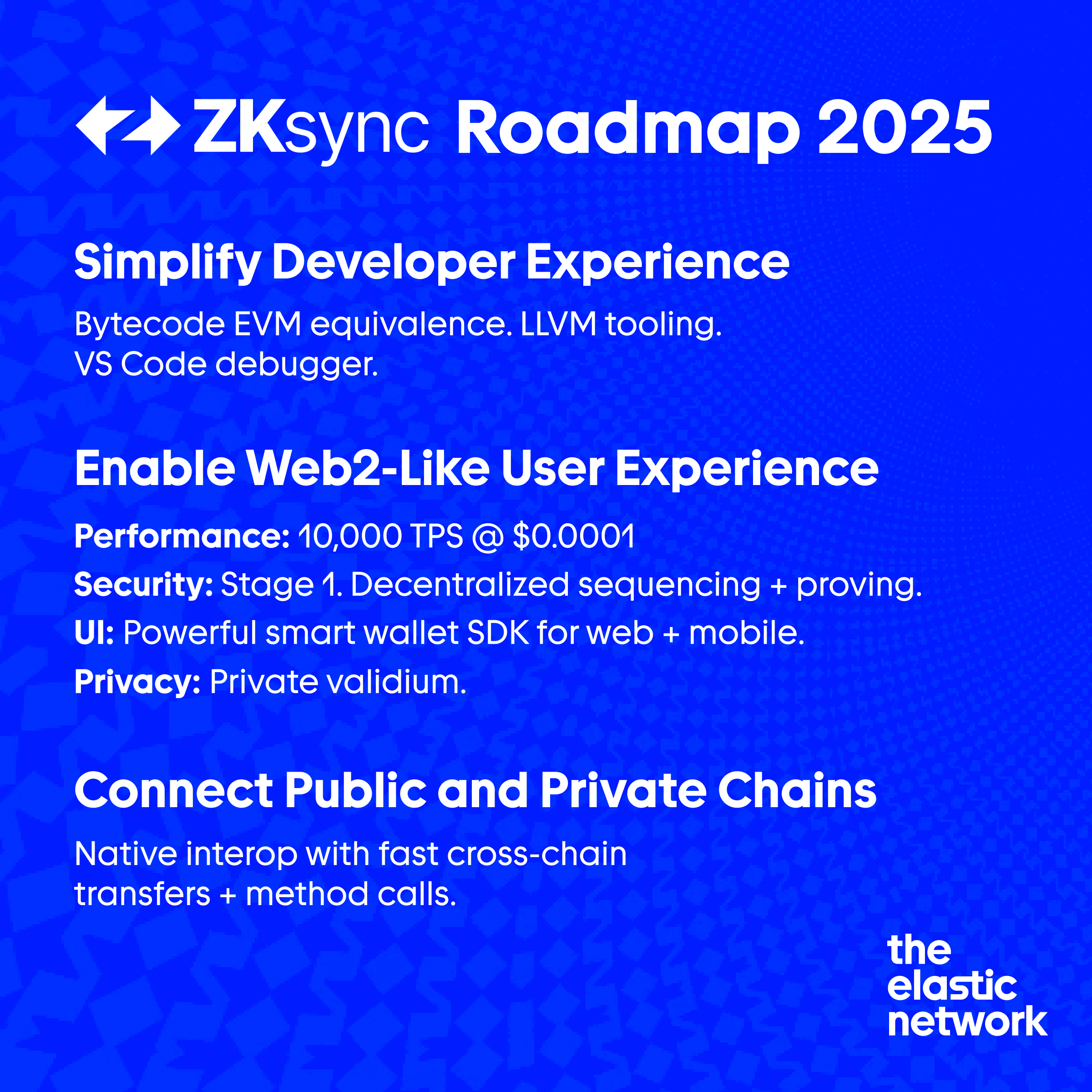
1. Simplifying the Developer Experience
For blockchain adoption to grow, developers need tools that are powerful yet easy to use. ZKsync is addressing this by prioritising Bytecode EVM equivalence, ensuring developers can use Ethereum’s tools and workflows seamlessly. No need for complicated adjustments—if it works on Ethereum, it works on ZKsync.
But ZKsync is taking it further:
- LLVM tooling will optimise smart contracts, making development more cost-efficient.
- VS Code debugger will bring familiar, intuitive debugging tools, saving developers time and effort.
This approach isn’t just about convenience—it’s about setting developers up for success. By offering tools that are both familiar and powerful, ZKsync creates an environment where developers can focus on building, not battling unnecessary complexity.
2. Bringing Web2 Simplicity to Web3
ZKsync understands that clunky user experiences are one of Web3’s biggest barriers to adoption. The 2025 roadmap tackles this head-on by introducing upgrades designed to make blockchain feel as smooth as Web2.
Here’s how they plan to do it:
- Performance: ZKsync is targeting a massive 10,000 TPS (transactions per second) at a cost of just $0.0001 per transaction.
- Security: The roadmap includes Stage 1 decentralised sequencing, ensuring that transactions are provably secure while avoiding centralised control.
- User Interface: ZKsync is reinventing wallet design with a smart wallet SDK for both web and mobile, delivering a user-friendly experience that removes friction for everyday users.
- Privacy: With private validium, enterprises will gain on-chain privacy for sensitive data—a critical step for large-scale adoption.
By prioritising speed, affordability, and simplicity, ZKsync is closing the gap between what users expect and what blockchain currently delivers. For Web2 users, the transition to Web3 will feel familiar, seamless, and intuitive—finally solving one of blockchain’s biggest pain points.
3. Seamlessly Connecting Public and Private Chains
Interoperability has been a persistent issue for blockchain ecosystems, but ZKsync’s approach to native cross-chain connectivity could change the game. Instead of relying on third-party bridges—often slow, insecure, and expensive—ZKsync is integrating seamless communication directly into its protocol.
Here’s why this matters:
- Chains will be able to transfer tokens, call methods, and share data securely and efficiently.
- ZKsync’s solution enables public and private ZK chains to work together, something previously unheard of.
This opens the door for enterprises, institutional players, and Web3-native ecosystems to operate in a single, interconnected network. Liquidity can flow freely, cross-chain apps will operate seamlessly, and private chains can collaborate with public networks while maintaining confidentiality.
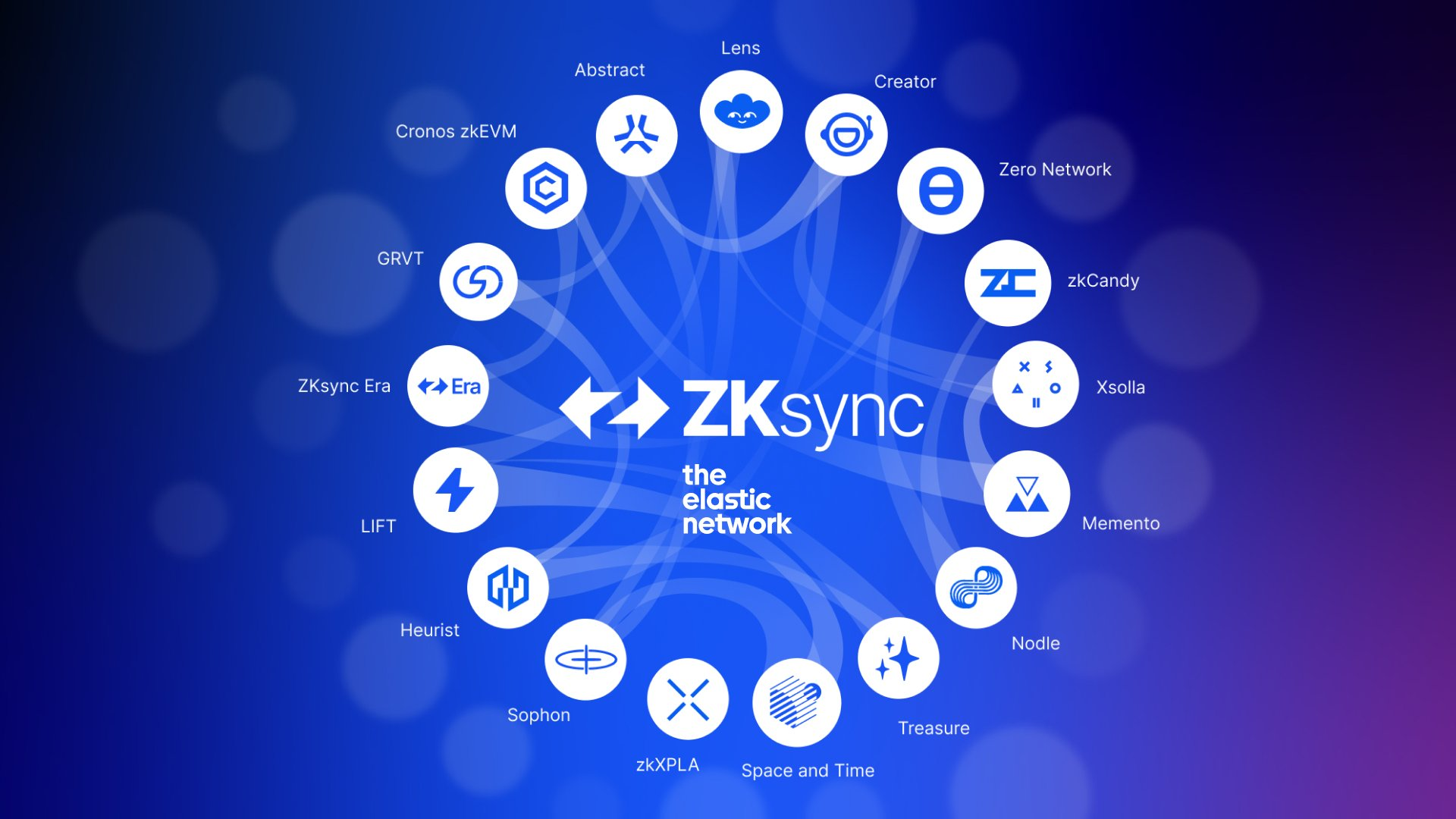
ZKsync’s vision is clear: to build an elastic network of ZK chains that function as a unified, fluid ecosystem. This isn’t just an upgrade—it’s a foundation for the future of blockchain interoperability.
The 2025 roadmap reflects ZKsync’s commitment to creating a blockchain ecosystem that works for everyone.
By simplifying developer tools, delivering a Web2-like experience, and solving the interoperability challenge, ZKsync is positioning itself to lead the next wave of Web3 adoption.
If ZKsync can deliver on these goals, it won’t just push the ecosystem forward—it will set a new standard for what blockchain can achieve: a seamless, accessible, and interconnected Web3, where freedom, performance, and trust come together.
ZKsync Era: The Evolution of the Chain
ZKsync Era is the flagship Layer 2 ZK Rollup designed to scale Ethereum without sacrificing security, decentralisation, or usability. Using Zero-Knowledge proofs, ZKsync Era processes transactions off-chain, bundles them into batches, and validates them on Ethereum Layer 1.
This means users get all the benefits of Ethereum’s security but with lower fees and higher throughput.
The leap from ZKsync Lite to ZKsync Era marks a major evolution. ZKsync Lite—previously known as ZKsync—was a more compact roll-up focused on payments, token swaps, and NFT minting, providing low-cost and secure transactions.
However, its scope was limited to simpler use cases. ZKsync Era, on the other hand, delivers a far more complete infrastructure. It supports smart contracts, DeFi protocols, and dApps, all written in familiar Solidity/Vyper.
It’s also natively interoperable, seamlessly connecting public and private ZK chains—something ZKsync Lite couldn’t do. For developers and users, ZKsync Era feels familiar: it supports existing Ethereum wallets and EVM-compatible tools out of the box.
ZKsync Era’s Role in the 2025 Roadmap
In ZKsync’s 2025 roadmap, ZKsync Era takes centre stage as the hub of the Elastic Network, playing three key roles:
- Governance:
ZKsync Era is where the Elastic Network was born—the site of its initial token generation events and governance decisions. As the network grows, ZKsync Era remains the central point for determining its future.
- Bridging and Infrastructure:
Era serves as the gateway to the Elastic Network, integrating deeply with bridges, exchanges, and oracles. Its native interoperability allows other ZK chains to plug directly into these resources, removing reliance on inefficient and costly third-party solutions.
- Liquidity and Capital Markets:
With over $1 billion in on-chain assets, ZKsync Era is the liquidity engine of the Elastic Network (previously Elastic Chain).
Its mature, secure architecture makes it an ideal venue for tokenised real-world assets (RWAs) and decentralised capital markets. Programs like ZKsync Ignite further drive growth, incentivising projects and sustaining capital flows.
By serving as the governance hub, liquidity source, and infrastructure backbone, ZKsync Era enables the Elastic Network to operate as a unified, interconnected ecosystem, supporting both new projects and institutional use cases.
ZKsync Era isn’t just another Layer 2—it’s the foundation of ZKsync’s vision for a seamless, scalable, and trustless blockchain future.
By offering a complete infrastructure and bridging the gap between public and private chains, it creates a network where scalability, performance, and decentralisation exist without compromise.
ZKsync’s Current Condition Promises Growth
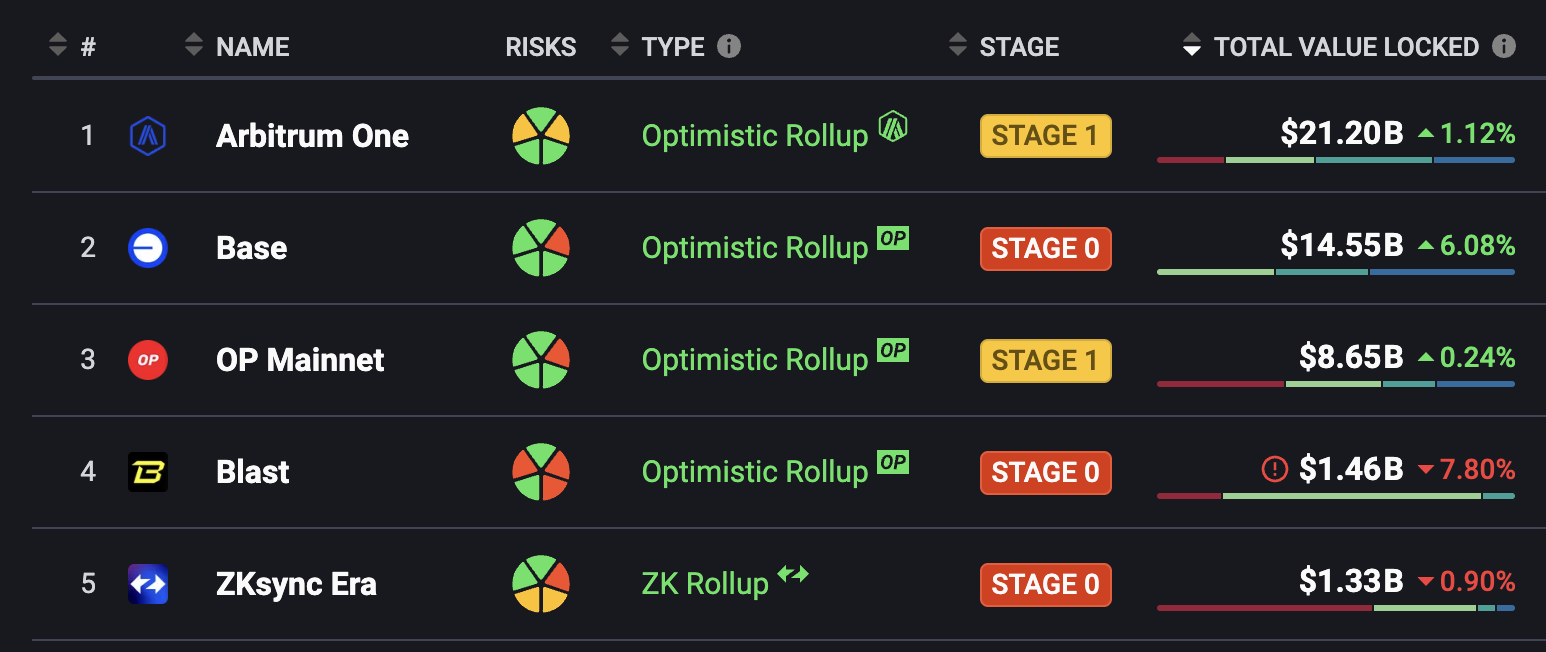
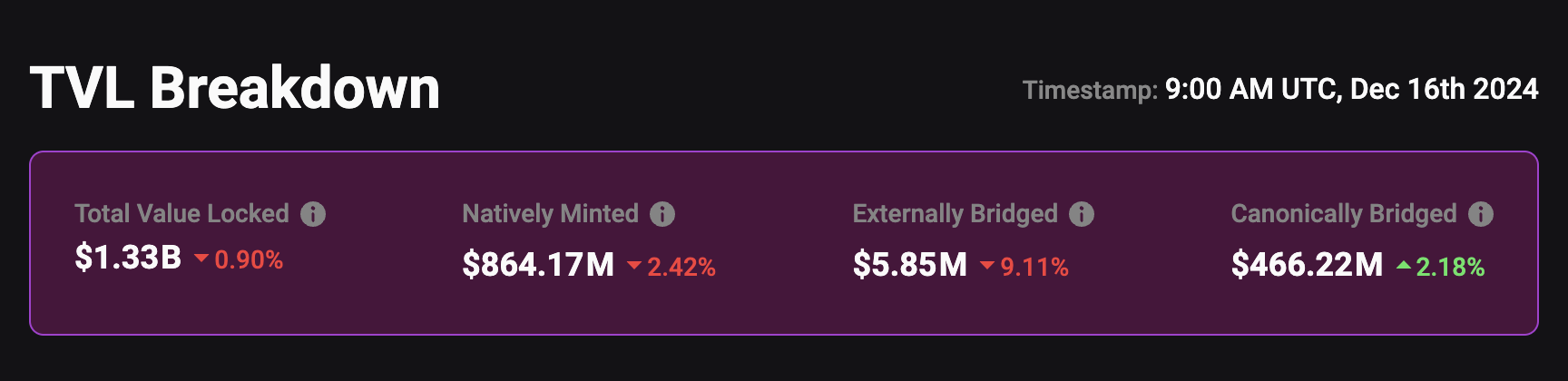
ZKsync Era currently holds a Total Value Locked (TVL) of $1.37 billion, placing it 5th among Layer 2 solutions. While the figure reflects a slight 3.22% decline, the breakdown offers important insights into the network’s liquidity.
Despite its strong fundamentals, ZKsync still has a gap to close compared to its competitors. Arbitrum One leads the Layer 2 pack with a massive $21.34 billion TVL, more than 15 times ZKsync’s current value.
Even Base, the second-largest L2, holds over $14 billion, while OP Mainnet and Blast come in at $8.78 billion and $1.47 billion, respectively. ZKsync sits just below Blast, separated by a small margin of roughly $100 million.
The majority of ZKsync’s TVL, which is $864.17 million (66%), comes from natively minted tokens, assets created directly on ZKsync. This highlights growing confidence from developers and projects building within the ecosystem, treating ZKsync as their home base.
The remaining $466.22 million (34%) consists of canonically bridged tokens, assets brought over from Ethereum Layer 1 through ZKsync’s official bridge, which shows Ethereum users’ trust in the network’s infrastructure.
Meanwhile, $5.85 million accounts for externally bridged tokens, assets transferred through non-canonical bridges, often originating from Ethereum and other Layer 1 chains like Polygon or BSC.
On the activity side, ZKsync is showing steady progress. Over the last 30 days, the network processed 4.5 million transactions, demonstrating consistent usage.
While these numbers show positive momentum, ZKsync’s ability to scale throughput and improve user experience, as outlined in its 2025 roadmap, could accelerate this growth even further.
While it still trails behind industry leaders, the network’s focus on performance, usability, and interoperability in the 2025 roadmap could push it higher in the rankings.
Conclusion
ZKsync’s 2025 roadmap lays out a bold plan to address Web3 adoption challenges by simplifying developer tools, enhancing user experiences, and achieving seamless interoperability between chains.
While it currently holds a strong position with $1.37 billion in TVL and rising network activity, its ambitious goals could help it close the gap with leading Layer 2 solutions.
If ZKsync delivers on its promises, it will not only elevate its standing but also set a new benchmark for what Layer 2 technology can achieve.