

75000 - 70000 years ago, modern humans (Homo Sapiens) migrated out of Africa, reached India by 65000 years ago. This first wave of migrants established itself in the subcontinent by successfully breeding and leaving behind descendants. 45000 - 20000 years ago, the descendants of Out of Africa migrants, called the First Indians began using microlithic technology, basically an upgrade to their stone tools, that helped them exploit the resources around more efficiently and enabled them to outcompete other 'Homo' species , whom they had circumvented 65000 years ago upon reaching India, who were soon driven to extinction and replaced by modern humans. This stone tools upgrade led to dramatic increase in the population of First Indians, making South Asia one of the most populated regions on the globe ever since.
9000 years ago in 7000BCE, one of the earliest agricultural settlement took shape in Mehrgarh, a village in Balochistan of Pakistan. Coinciding with this event (7000BCE), was the migration of Zagrosian agriculturalists from Iran into North Western India, who brought wheat, barley non native grasses to India. This led to the hypothesis that migrant Zagrosians were responsible for the beginning of agricultural revolution in South Asia or that farming in India was a West Asian (Near East) import. But simultaneously there were agricultural endeavours undertaken in other parts of India like in Lahuradewa of Uttar Pradesh. Evidence for rice harvesting in sedentary settlements has been found. Even in Mehrgarh traces of farming even before 7000BCE have been found. This made some scholars hypothesize, agricultural farming in India was autochthonous in nature, a native development. Another interpretation of archaeological evidences available is, farming was taken up in various places around the globe around the same time simultaneously; Neolithic/ agricultural revolution in India/South Asia was a native development catalysed by the migration of agriculturalists from Zagros mountains of Iran. Opinions are still split on this one, jury is still out.
From 7000BCE to 3000BCE, migrants from Zagros heavily mixed with the early population of First Indians, the descendants of this mixture would go on to be the Harappans who built the Indus Valley Civilization.
From 7000BCE to 2600BCE, there is increased cultivation of barley, wheat and other crops, increase in consumption of domesticated animals. This agricultural revolution lead to another population explosion in the subcontinent.
To summarize, the Out of Africa migrants reach India by 65000 years ago, their descendants spread across the subcontinent as a result of adoption of microlithic technology, continue to live as hunter gatherers until 9000BCE, when experiments in farming in few places lead to sedentary life in early agricultural settlements. Around 7000BCE, Zagrosian agriculturalist migrants from Iran bring with them their own farming technologies along with West Asian (also called as Near East) origin crops like Barley, wheat and West Asian domesticated sheep and mix with the First Indians. These developments catalyse neolithic revolution in South Asia, which lead to the rise of Indus Valley Civilization.
The period from 7000 - 5500BCE that encompassed early agricultural developments is called pre Harappan era. Indus Age is divided into three phases, that lasted from 5500 - 1800BCE.
5500 - 2600BCE is termed the Early Harappan Era when the early agricultural settlements of Kalibangan, Rakhigharhi, Banawali and Rahman Dheri turned into towns. This phase set the stage for the mature Harappan phase between 2600 - 1900BCE.
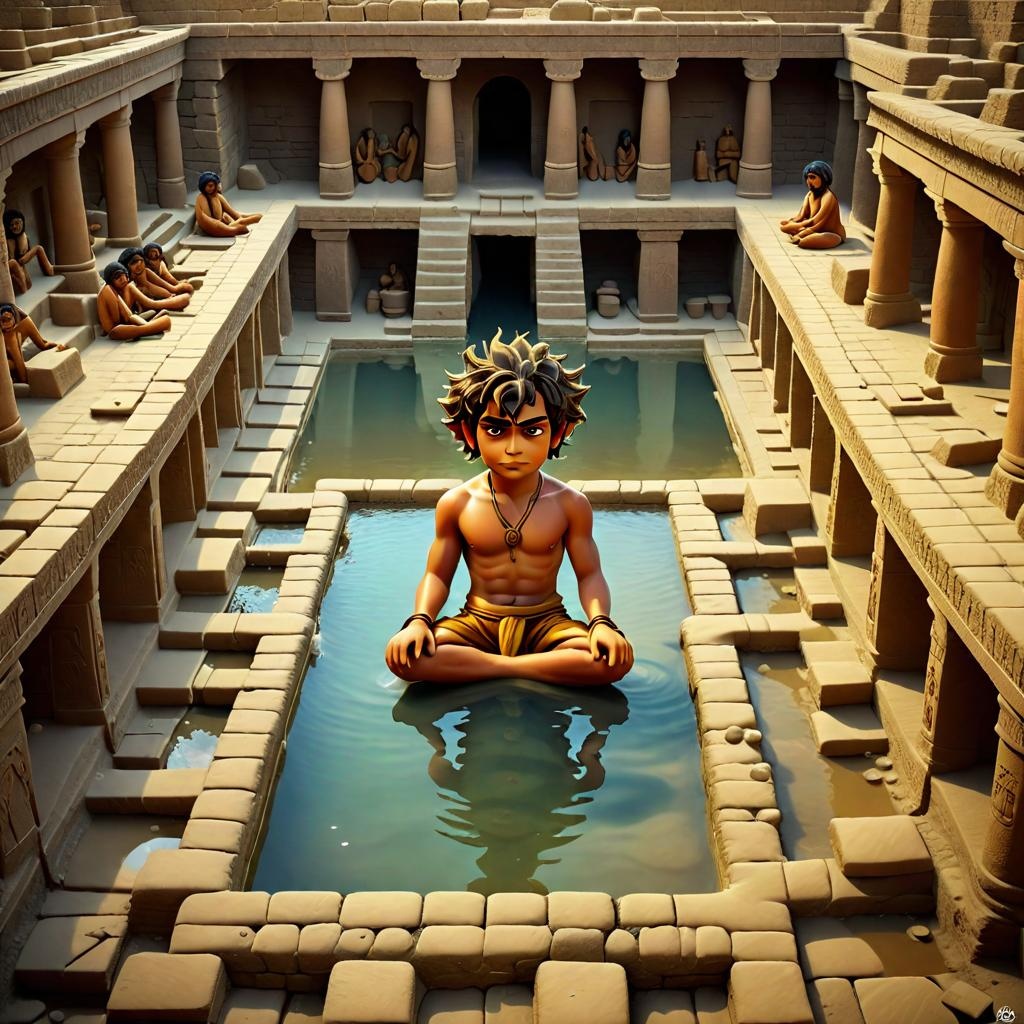
Mature Harappan phase between 2600 - 1900BCE is the peak Indus Valley Civilization. This is when, the Indus realm witnessed peak standardisation and urbanization. Now what kind of governance brought this up has been so far a mystery, that one can only speculate on. The archaeological evidence shows uniformity in material culture, seals with common script and common motifs, standardized weights during the mature period across the Indus realm. New sites were built, old sites were rebuilt, mature phase is characterized by peak urbanization with increased trade within the Indus realm and with contemporary bronze age cultures around and overseas. Urban planning is the most striking aspect of Indus Valley Civilization, the cities had intricate layouts with well planned residential and public buildings, planned lanes and streets, water engineering works like what might have been a public bath at MohenjoDaro, dams, wells in individual houses or group of houses, waste management and more. Nowhere in history before or after until 19th century modern Europe do we see such advanced urban planning. This should give us an idea on how ahead of time the civilization was. The houses were built with baked bricks, many were multi storeyed. There's lot more to write about this phase, all the glories of Indus Valley Civilization, but of course in future articles.
2500 - 1300 BCE world witnessed a global scale climate change or crisis, that would eventually disintegrate highly populated, urbanized, trading sedentary cultures across the world as these settled population groups found the climate change devastating to cope with and continue their urban lifestyle.
2300 - 1700 BCE saw the rise of Bactria - Margiana Archaeological Complex (BMAC), a civilization that thrived on the Oxus river (Amu Darya). It spread across modern northern Afghanistan, southern Uzbekistan and western Tajikistan. Indus people traded extensively with BMAC and had noteworthy cultural exchanges and relations.
In 2100BCE, Kazakh steppe pastoralists, native speakers of Indo European languages started migrating south towards BMAC civilization, but left little to no impact on the region. Through the next millenium from 2000BCE - 1000BCE, multiple waves of these steppe pastoralists aggressively moved towards and into South Asia from Central Asia sending shock waves to the Indus Valley Civilization and its people, already in decline due to global scale climate crisis. This population brought Indo European languages, new religion and culture to the subcontinent and forced their way of life on the existing population. So the Indo European speaking migrants of Kazakh steppe that's in Northern Central Asia migrate towards BMAC situated in Southern Central Asia, strangely leaving little impact on the region migrate to Indus Valley Civilization of South Asia and settle there.
1900 - 1300 BCE is termed the late Harappan period during which Indus Valley Civilization declined and by the end disappeared due to various factors, from failing to cope with global climate crisis to grave challenge posed by aggressive steppe migrants who were in search of greener pastures (and female mates as the band mostly consisted of men) as steppe was affected by the climate crisis more severely than anywhere else. The late Harappan period saw the collapse of urban centres, trade overseas and within as well, discontinued use of Indus script never to be used again, seals, abandonment of cultural, political beliefs that held the Indus Valley Civilization together and fuelled it to function to excellence.
1500BCE onwards saw the steppe migrants gain power in the subcontinent, pushing the previously successful population of Harappans socially downwards to the bottom of hierarchy leaving them with no political, economic power, taking control of abundant natural resources of South Asia.
1500 - 500BCE, the steppe migrants who called themselves 'Aryans' composed Rigveda followed by other vedic literature in Sanskrit. Use of Harappan script was never seen again since its decline in 1900BCE.
British Raj lasted from 1858 - 1947 (colonization started much before though), during which ambitious/extensive archaeological expeditions were undertaken across South Asia led by top notch British archaeologists. Indus Valley Civilization was discovered in the 1920's, excavation began in Harappa, MohenjoDaro overseen by John Marshall, one of the best archaeologists of his time (and all times) was Director General of the Archaeological Survey of India from 1902 to 1928. The 1947 Partition of India resulted in some Indus sites being part of Pakistan, some remained with India.
Meluhha/Melukhkha is the Sumerian name for the Harappan regions, possibly Harappans themselves called their land that. They were excellent tradesmen, Yoga, Indian cosmology, Chess have their roots in Harappan Civilization. We can also add Ayurveda, Indian Classical music to the list.
Since Indus script hasn't been deciphered yet, there are more things we don't know about the Civilization than we can infer from the available archaeological evidences.
We don't know exactly what languages they spoke or what they sounded like (Dravidian languages are considered likely candidates, more on this in future articles). There are many questions about IVC we don't have a clear answer to. There are theories based on archaeological, linguistic and (most definitive) genetic evidences and analysis. For some questions we almost know, but there's more evidence needed to fill the gap in the narrative to conclusively reach a consensus.
We don't know who ruled the IVC, who was the authority, what kind of governance held sway over the people of IVC and kept the Indus system functioning, what kind of cultural and political narratives were employed by the authority or was there even an authority. How did people of IVC organize themselves socially, what kind of social hierarchy controlled them. Answers to these questions elude historians as archaeologists haven't been able to identify remains of any building as royal palace, temple, no sign of royal burials, no artistic representation of ruler or priest. The Harappan infrastructure, burials signal no stark social division amongst the people, unlike other bronze age civilizations the IVC seems unusually egalitarian and peaceful . There is no evidence for wars, weapons, fortifications, no artistic representation of violence.
Was IVC an adaptive response to native environmental challenges and abundance or was it the result of contact with West Asian civilizatons? Who were the people who built IVC, were they indigenous or migrants, which current population/ community of South Asia or world is related to the Harappans the most? What male lineages drove the civilization forward? What language/languages did the Harappans speak, what did it sound like, are there any direct descendants or related languages spoken by any current population in South Asia or anywhere else? Did it belong to the language family of Dravidian of South India, Munda of East India or Indo European of North India? Is the language on the Indus seals, language of the Indus script Sanskrit? Is modern Hinduism derived from the religions of IVC, or Aryan in origin with no impact from what preceded the Aryan culture, or are the similarities just coincidences and wishful thinking? And lastly what factors led to the collapse of IVC, was it due to climate factors, or attack of steppe migrants or something entirely different and yet to chance upon?
These are the questions that intrigue people fascinated by IVC. Some of which we have been able to find partial answers to, some we don't have any answer to, and some need little more information or evidence to fill the gap in the narrative to complete the puzzle of IVC.
These are the questions the following articles will try to confront and reach an interesting and hopefully agreeable answer.